English
  Български
  Deutsch
  العربية
  Čeština
  Dansk
Dansk  Ελληνικά
  Español
  Eesti
Eesti  Suomi
Suomi  Русский
  Türkçe
  Français
  Magyar
  Bahasa Indonesia
  Italiano
  日本語
日本語  한국어
한국어  Lietuvių
  Latviešu
  Norsk Bokmål
  Nederlands
  Polski
  Português
  Română
  Slovenčina
  Slovenščina
  Svenska
  Ukrainian
  中文
中文 
Understanding Affiliate Commission Models: CPA, CPM, Revenue Share, and Why Blockchain Changes Everything


Introduction
The affiliate marketing industry generates over $12 billion annually in the United States alone, with successful affiliates earning anywhere from supplemental side income to seven-figure annual revenues. However, the commission structure of an affiliate program fundamentally determines earning potential, income stability, and long-term value. Two affiliates with identical traffic and conversion rates can earn dramatically different amounts depending solely on whether their program pays through cost-per-action, revenue share, recurring commissions, or other models.
Understanding the various affiliate commission structures is essential for making informed decisions about which programs to promote and how to allocate promotional efforts. Each commission model has distinct advantages, disadvantages, and optimal use cases. More importantly, emerging blockchain technology is fundamentally transforming affiliate commission structures, introducing possibilities that were technically impossible with traditional centralized systems. Slaff.io represents the pioneering implementation of blockchain-recorded lifetime commissions, creating a commission model that combines the best aspects of multiple traditional structures while eliminating their inherent vulnerabilities.
This comprehensive guide examines all major affiliate commission models, from traditional structures like cost-per-action and cost-per-click to advanced models like revenue share and recurring commissions. We will analyze the mechanics of each model, their advantages and limitations, typical payout ranges, and optimal use cases. Most importantly, we will explore how blockchain technology enables a revolutionary new commission structure—permanent, lifetime commissions guaranteed by smart contracts rather than corporate promises—and why this represents the future of affiliate marketing.
CPA (Cost Per Action): One-Time Payment for Conversions
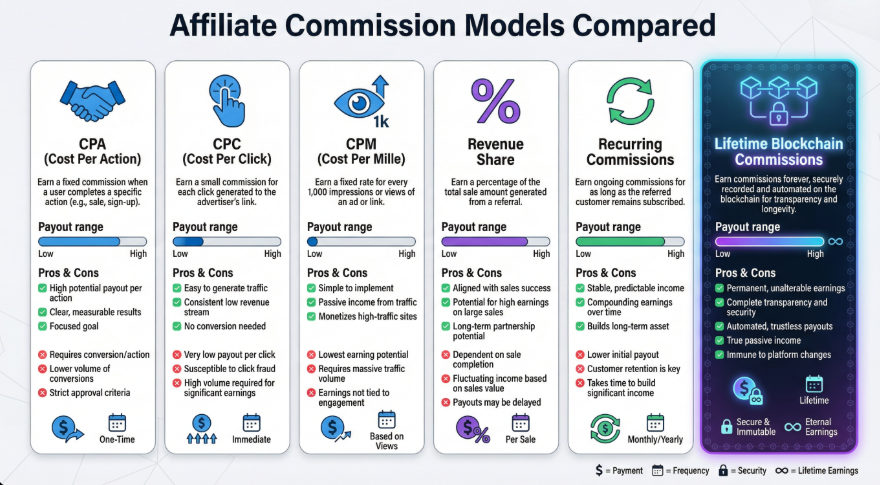
Cost Per Action, also called Cost Per Acquisition, represents the most straightforward affiliate commission model. Affiliates earn a fixed payment each time a referred user completes a specific action—typically a purchase, registration, or subscription. This model dominates e-commerce affiliate programs and has been the standard for decades.
How CPA Works
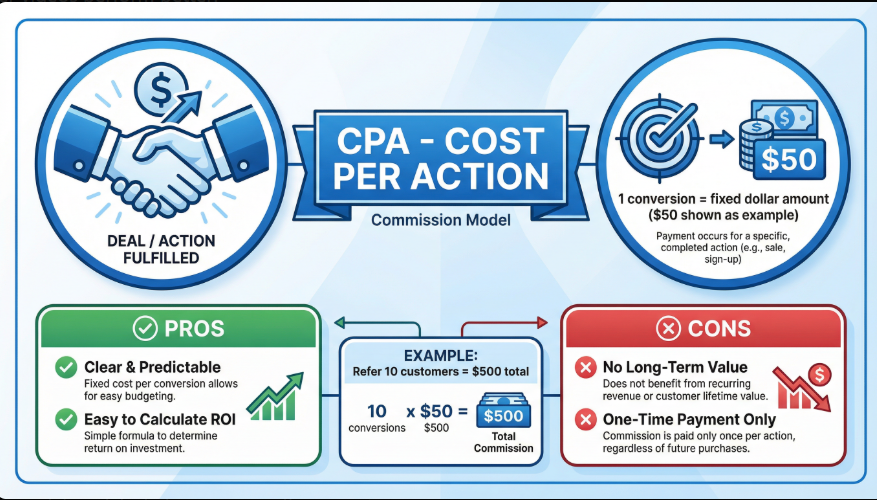
Under a CPA model, the affiliate promotes a product or service through their unique referral link. When someone clicks that link and completes the defined action (makes a purchase, signs up for a service, submits a form, etc.), the affiliate receives a predetermined commission payment. The payment amount is fixed regardless of the value of the transaction or the customer's subsequent behavior.
For example, an e-commerce affiliate program might pay $50 for each new customer who makes their first purchase. Whether that customer buys a $100 product or a $1,000 product, the affiliate receives the same $50 commission. Similarly, whether that customer becomes a loyal repeat buyer or never returns, the affiliate's earnings remain unchanged.
Advantages of CPA Models
The primary advantage of CPA models is clarity and predictability. Affiliates know exactly how much they will earn for each conversion, making it straightforward to calculate return on investment for paid advertising and other promotional expenses. If an affiliate knows they earn $50 per conversion and their average conversion rate is 2%, they can calculate that 1,000 visitors will generate approximately 20 conversions and $1,000 in commissions.
CPA models also provide immediate gratification and clear success metrics. Each conversion represents a tangible win with a known monetary value, creating psychological motivation and making it easy to track performance. For affiliates just starting out, the simplicity of "refer a customer, earn $X" is appealing and easy to understand.
From the merchant's perspective, CPA models align costs directly with results. The company only pays commissions when they acquire actual customers, making the cost structure predictable and performance-based. This alignment makes CPA attractive for businesses with tight margins or limited marketing budgets.
Disadvantages and Limitations
The fundamental limitation of CPA models is that affiliates capture none of the long-term value they create. If an affiliate refers a customer who goes on to spend $10,000 over several years, the affiliate still receives only the initial $50 commission. This creates a misalignment between the value the affiliate generates and the compensation they receive.
CPA models also create no ongoing relationship between the affiliate and the customer. Once the initial conversion occurs and the commission is paid, the affiliate has no further stake in that customer's success or continued engagement. This eliminates any incentive for the affiliate to provide ongoing support, education, or encouragement that might increase customer lifetime value.
For high-value products or services, CPA commissions often seem inadequate relative to the effort required to generate conversions. Referring a customer for a $10,000 investment opportunity that pays a $100 CPA commission feels disproportionate, potentially discouraging affiliates from promoting despite the high transaction value.
Typical CPA Payout Ranges
CPA commission amounts vary dramatically based on industry, product price point, and customer lifetime value. Low-value consumer products might pay $5-$25 per conversion, while financial services, B2B software, and high-value products might pay $50-$500 or more per conversion. Some luxury or enterprise products offer CPA commissions exceeding $1,000 for a single qualified lead or sale.
CPC (Cost Per Click): Payment for Traffic Generation
Cost Per Click models compensate affiliates based on the number of clicks they generate to the merchant's website, regardless of whether those clicks result in conversions. This model is common in display advertising networks and some content-focused affiliate programs.
How CPC Works
Affiliates place links, banners, or other promotional content containing their unique tracking code. Each time someone clicks on that content and visits the merchant's website, the affiliate earns a small commission—typically ranging from a few cents to a few dollars per click, depending on the industry and competition.
The key distinction from CPA models is that payment occurs for the click itself, not for any subsequent action the visitor takes. Whether the visitor immediately bounces, browses for hours, or makes a purchase, the affiliate receives the same per-click payment.
Advantages of CPC Models
CPC models make it easy for affiliates to generate consistent revenue from high-traffic properties without requiring conversions. A content website with 100,000 monthly visitors can earn predictable income by placing CPC affiliate links throughout their content, even if conversion rates are low. This makes CPC attractive for publishers focused on traffic generation rather than conversion optimization.
The low barrier to earnings means affiliates can start generating revenue immediately without mastering conversion optimization, copywriting, or sophisticated marketing techniques. Simply driving traffic is sufficient, making CPC accessible to beginners and content creators who excel at audience building but may lack sales skills.
From the merchant's perspective, CPC models provide guaranteed traffic volume, which has value even without immediate conversions. Brand exposure, retargeting opportunities, and the potential for delayed conversions mean traffic itself has worth beyond immediate sales.
Disadvantages and Limitations
The fundamental problem with CPC models is the extremely low payment per click. Even in competitive industries, CPC rates rarely exceed $2-$3 per click, and many programs pay $0.10-$0.50 per click. This means affiliates need massive traffic volume to generate meaningful income. Earning $1,000 per month at $0.25 per click requires 4,000 clicks—a substantial traffic requirement.
CPC models also create misaligned incentives. Affiliates are rewarded for generating clicks regardless of quality, potentially encouraging clickbait tactics, misleading headlines, or traffic from irrelevant sources. This can damage the merchant's brand and waste marketing budget on low-quality traffic that will never convert.
The lack of connection to actual business results means CPC affiliates have no stake in the merchant's success. Whether the traffic they generate produces millions in revenue or zero conversions, their earnings remain unchanged. This eliminates any incentive to optimize for conversion quality or customer fit.
Typical CPC Payout Ranges
CPC rates vary dramatically by industry and competition. Highly competitive industries like finance, insurance, and legal services might pay $1-$5 per click, while less competitive niches might pay $0.05-$0.50 per click. The average CPC across all industries typically falls in the $0.25-$1.00 range.
CPM (Cost Per Mille): Payment Per 1,000 Impressions
Cost Per Mille (mille meaning thousand in Latin) compensates affiliates based on the number of times their promotional content is displayed, regardless of whether anyone clicks or converts. This model is most common in display advertising and banner ad networks.
How CPM Works
Affiliates place banner ads, display widgets, or other visual promotional content on their website or platform. Each time that content is displayed to a visitor (an "impression"), it counts toward the affiliate's total. When the affiliate accumulates 1,000 impressions, they receive the CPM payment—typically ranging from $1-$20 per thousand impressions, depending on audience quality and industry.
The key characteristic is that payment occurs for visibility alone. The visitor doesn't need to click, engage, or take any action. Simply seeing the promotional content is sufficient to generate earnings for the affiliate.
Advantages of CPM Models
CPM models provide the most passive form of affiliate income. Once promotional content is placed, it generates earnings automatically based purely on traffic volume. A website with consistent traffic can earn predictable CPM revenue without any active promotion, conversion optimization, or ongoing effort.
This model works exceptionally well for high-traffic publishers who may have audiences that don't convert well on affiliate offers but still have value through sheer volume. A entertainment or news website with millions of monthly visitors can generate substantial CPM revenue even with minimal engagement.
CPM models also create no friction in the user experience. Since no click or action is required, there's no disruption to the visitor's browsing experience, potentially making CPM placements more acceptable on content-focused websites where aggressive conversion tactics might alienate audiences.
Disadvantages and Limitations
The fundamental limitation of CPM models is the extremely low earning potential per impression. Even at a generous $20 CPM (which is rare), 1,000 impressions generate only $20. To earn $1,000 per month requires 50,000 impressions—substantial traffic that many affiliates never achieve.
CPM models provide the lowest earnings of any commission structure for most affiliates. Unless traffic volume is massive (hundreds of thousands or millions of monthly visitors), CPM revenue will be minimal. This makes CPM unsuitable for affiliates with modest traffic or those promoting high-value products where conversion-based models would generate far more revenue.
The complete disconnect from business results means CPM affiliates have zero incentive to optimize for conversions, customer quality, or merchant success. This can lead to poor placement quality, irrelevant audiences, and wasted advertising spend for merchants.
Typical CPM Payout Ranges
CPM rates vary dramatically based on audience quality, niche, and geographic location. Premium audiences in high-value industries (finance, B2B, technology) might command $10-$50 CPM, while general audiences in less valuable niches might see $1-$5 CPM. The average CPM across most affiliate programs falls in the $2-$10 range.
Revenue Share: Percentage of Transaction Value
Revenue share models, also called percentage-based commissions, pay affiliates a percentage of the revenue generated from their referred customers. This model aligns affiliate earnings directly with transaction value, creating a more equitable relationship between effort and compensation.
How Revenue Share Works
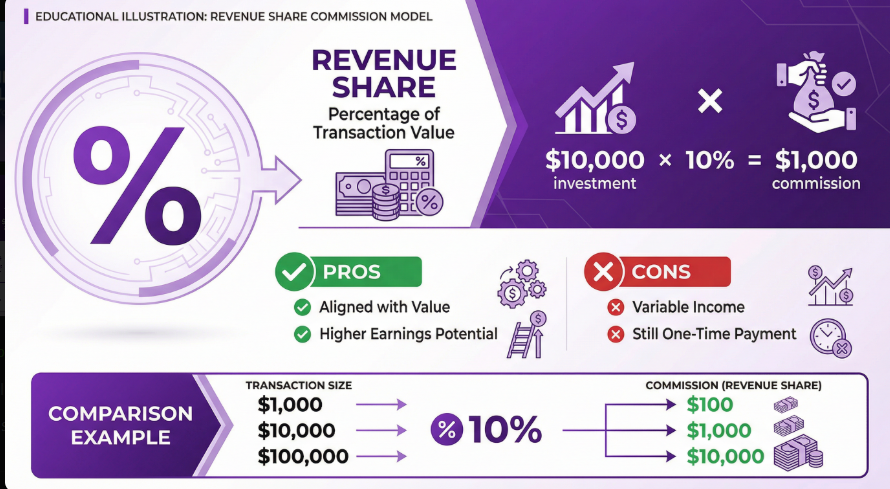
When an affiliate refers a customer who makes a purchase, the affiliate receives a predetermined percentage of that transaction value as commission. For example, a 10% revenue share on a $1,000 purchase generates $100 in affiliate commission, while the same 10% on a $10,000 purchase generates $1,000.
Some revenue share programs pay a percentage of the first transaction only (similar to CPA but variable based on transaction size), while others pay a percentage of all transactions the customer makes, either for a limited time period or indefinitely.
Advantages of Revenue Share Models
The primary advantage of revenue share is alignment between affiliate effort and compensation. Affiliates who refer high-value customers or encourage larger transactions earn proportionally more, creating incentive to focus on quality over quantity and to promote effectively to audiences with higher purchasing power.
This alignment also encourages affiliates to provide better pre-sale education and support. Since their earnings increase with transaction size, affiliates benefit from helping customers understand the full value proposition and make informed decisions about larger purchases or premium options.
Revenue share models can generate substantially higher earnings than fixed CPA for high-value products. An affiliate promoting Slaff.io investment opportunities with a 10% revenue share would earn $500 on a $5,000 investment—far more than most fixed CPA programs would pay.
Disadvantages and Limitations
The variability of revenue share can make income less predictable. Unlike fixed CPA where every conversion generates known earnings, revenue share fluctuates based on customer purchase decisions. This makes it harder to calculate ROI for paid advertising and forecast income.
Revenue share models also create dependency on factors outside the affiliate's control. If the merchant raises prices, the affiliate benefits; if they lower prices or offer discounts, the affiliate's earnings decrease. Changes in product mix, average order value, or pricing strategy directly impact affiliate income without any change in the affiliate's performance.
For low-margin products or services, revenue share percentages may seem high but generate modest absolute earnings. A 30% revenue share on a $50 product generates only $15—less than many fixed CPA programs would pay for the same conversion.
Typical Revenue Share Percentages
Revenue share percentages vary widely by industry and margin structure. Digital products and services with high margins often offer 20-50% revenue share, while physical products with lower margins might offer 5-15%. Financial services and investment platforms like Slaff.io typically offer 5-10% revenue share on transaction values, which can generate substantial absolute earnings given high transaction sizes.
Recurring Commissions: Ongoing Payments for Subscription Customers
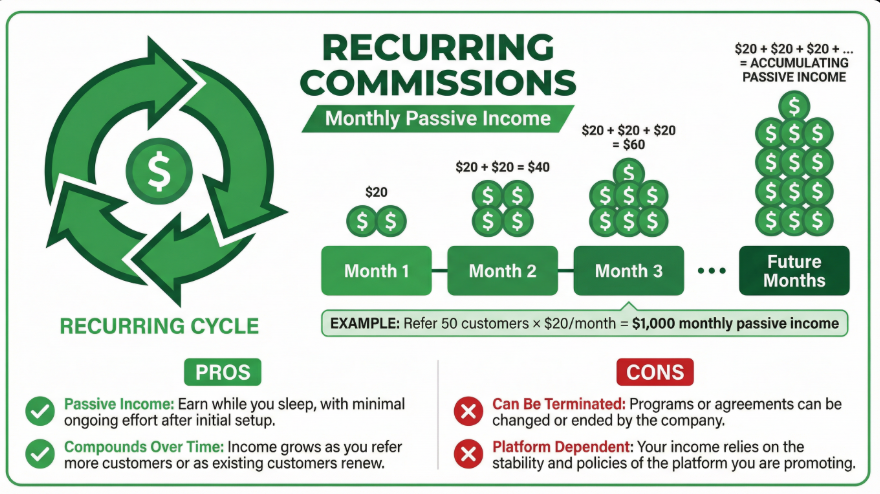
Recurring commission models pay affiliates ongoing commissions for as long as their referred customers remain subscribed or continue making purchases. This model is common in subscription-based businesses (SaaS, membership sites, subscription boxes) and represents a significant improvement over one-time CPA models.
How Recurring Commissions Work
When an affiliate refers a customer who subscribes to a recurring service, the affiliate receives a commission payment each billing cycle for as long as that customer remains subscribed. For example, if an affiliate refers a customer to a $100/month software subscription with a 20% recurring commission, the affiliate earns $20 per month for as long as that customer continues their subscription—potentially for years.
This creates a compounding effect where each new referral adds to the affiliate's monthly recurring revenue. An affiliate who refers 50 customers in their first year, with an average subscription duration of 2 years, builds substantial ongoing passive income that continues long after the initial promotional effort.
Advantages of Recurring Commission Models
Recurring commissions create true passive income that compounds over time. Unlike CPA models where affiliates must constantly generate new conversions to maintain income, recurring models build a base of ongoing earnings that provides income stability and rewards long-term relationship building.
This model aligns affiliate incentives with customer retention and satisfaction. Since affiliates continue earning only while customers remain subscribed, they benefit from referring qualified customers who will find genuine value in the service and remain long-term subscribers. This encourages quality over quantity and creates incentive for affiliates to provide post-sale support and encouragement.
The compounding effect of recurring commissions means affiliate income can grow exponentially even with consistent (rather than increasing) promotional efforts. Each month's new referrals add to the base of recurring revenue, creating a snowball effect that can generate substantial passive income over time.
Disadvantages and Limitations
The primary limitation of recurring commission models is the time required to build substantial income. Unlike CPA models that provide immediate earnings, recurring models start with small amounts that grow gradually. This delayed gratification can be discouraging for affiliates seeking quick returns.
Recurring commissions also create dependency on factors outside the affiliate's control. If the merchant increases prices, the affiliate benefits; if they lower prices, the affiliate's income decreases. If the merchant's product quality declines and churn increases, the affiliate's recurring revenue evaporates through no fault of their own.
Many recurring commission programs include limitations that reduce their long-term value. Some programs cap recurring commissions at a certain number of months (e.g., "recurring for 12 months"), after which the affiliate stops earning even if the customer remains subscribed. Others reduce the commission percentage over time or reserve the right to modify commission structures, potentially decreasing affiliate earnings retroactively.
Typical Recurring Commission Structures
Recurring commission percentages typically range from 10-30% of the monthly subscription value, though some programs offer higher percentages. The duration of recurring payments varies—some programs pay for the lifetime of the subscription, while others cap at 12-24 months. The most generous programs offer lifetime recurring commissions without caps or reductions, though these are relatively rare in traditional affiliate marketing.
Lifetime Commissions: The Traditional Promise (and Its Limitations)
Some traditional affiliate programs advertise "lifetime commissions," promising to pay affiliates for all purchases their referred customers make indefinitely. This sounds ideal—refer a customer once, earn commissions forever. However, traditional lifetime commission programs have significant limitations and vulnerabilities that undermine their promise.
The Problem with Traditional Lifetime Commissions
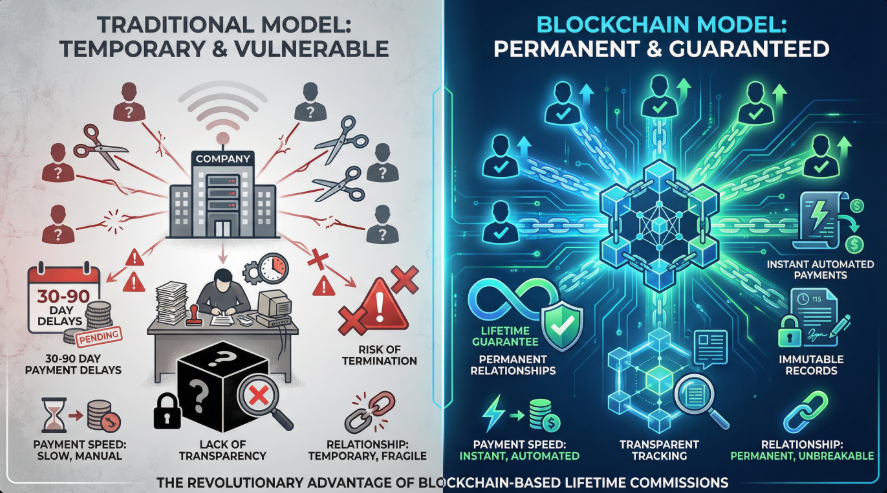
Traditional lifetime commission programs are recorded in the merchant's private database and governed by the terms of service that the merchant controls and can modify at will. This creates several fundamental vulnerabilities that have been dramatically demonstrated by events like Booking.com's May 2025 "Bookinggeddon," where thousands of affiliates lost their lifetime commission relationships with just 30 days' notice.
Arbitrary termination risk means the merchant can end the affiliate relationship at any time, for any reason, eliminating all future earnings from previously referred customers. Affiliates who spent years building referral networks can lose their entire passive income stream overnight through no fault of their own.
Opaque tracking and verification means affiliates must trust the merchant's private database to accurately track referrals and attribute commissions. There's no independent way to verify that all referrals are being properly credited or that commissions are being calculated correctly. Disputes are resolved by the merchant, who controls all the data.
Payment delays and processing in traditional systems typically involve 30-90 day waiting periods between when a commission is earned and when it's paid. During this time, the merchant holds the funds, and affiliates have no guarantee of payment until it actually arrives.
Terms of service changes allow merchants to modify commission rates, payment terms, or program rules retroactively. Affiliates who built their business around a 10% commission rate might suddenly find it reduced to 5%, cutting their income in half with no recourse.
Platform dependency means affiliates' entire income stream depends on a single company's continued operation and goodwill. If the company is acquired, changes strategy, or goes out of business, the affiliate's lifetime commissions disappear.
These limitations mean that traditional "lifetime commissions" are actually "lifetime commissions at the merchant's discretion"—a far less valuable proposition. The promise of lifetime earnings is only as reliable as the company making the promise, and as thousands of Booking.com affiliates learned in May 2025, that promise can be revoked at any time.
Blockchain-Guaranteed Lifetime Commissions: The Revolutionary New Model
Blockchain technology enables a fundamentally new commission structure that eliminates the vulnerabilities of traditional lifetime commission programs while providing benefits that were technically impossible before. Slaff.io pioneered this model, creating the world's first blockchain-recorded affiliate program for tokenized investments.
How Blockchain-Guaranteed Commissions Work
When an affiliate refers a customer to Slaff.io, that relationship is recorded permanently on the blockchain through a smart contract. This creates an immutable, publicly verifiable record that the affiliate referred this specific customer. The smart contract automatically executes commission payments whenever the referred customer makes an investment, with no manual processing, delays, or potential for disputes.
The blockchain recording means the affiliate relationship is permanent and cannot be revoked. Unlike traditional programs where the merchant can terminate partnerships at will, blockchain-recorded relationships are written into the ledger and cannot be erased or modified. Once the relationship is recorded, the affiliate will earn commissions on that customer's investments forever, guaranteed by code rather than corporate policy.
Smart contract automation means commissions are paid instantly and automatically when investments occur. There are no 30-90 day payment delays, no manual processing, and no possibility of the company deciding not to pay. The smart contract executes automatically, transferring the commission to the affiliate's wallet the moment the investment is made.
The Revolutionary Advantages
Permanent, irrevocable relationships mean affiliates can never experience a "Bookinggeddon" scenario where their income stream is terminated arbitrarily. Once a referral relationship is recorded on the blockchain, it exists permanently. The company cannot revoke it, modify it, or terminate the affiliate's earnings from that relationship. This transforms affiliate marketing from a precarious, at-will arrangement into a permanent asset that generates income for life.
Complete transparency and verifiability through the public blockchain means affiliates can independently verify every referral, every commission, and every transaction. There's no need to trust the company's private database—everything is recorded on the public ledger where anyone can audit it. This eliminates disputes about attribution, tracking, or commission calculations.
Instant, automated payments through smart contracts mean affiliates receive their commissions immediately when investments are made, with no delays, no manual processing, and no possibility of payment being withheld. The commission transfer is automatic and guaranteed by the smart contract code.
Immunity to platform changes means that even if Slaff.io changes ownership, modifies its business model, or ceases operations, the blockchain-recorded relationships and smart contract commission guarantees remain in effect. The affiliate's earnings are secured by the blockchain itself, not by the company's continued operation or goodwill.
True passive income results from the combination of lifetime commissions and permanent relationships. Every customer an affiliate refers becomes a permanent source of passive income that generates commissions on all future investments, compounding over time as customers increase their investment activity. This creates exponentially growing passive income that traditional programs cannot match.

Why This Changes Everything for Affiliate Marketing
The blockchain-guaranteed lifetime commission model represents the most significant innovation in affiliate marketing in decades. It transforms affiliate relationships from temporary, revocable arrangements into permanent, valuable assets. An affiliate who refers 100 investors to Slaff.io has created a permanent income stream that will generate commissions for life, regardless of any future platform changes or business decisions.
This permanence creates fundamentally different economics for affiliates. Instead of constantly needing to generate new referrals to maintain income (as with CPA models) or depending on the merchant's continued goodwill (as with traditional recurring models), blockchain affiliates build permanent assets that compound over time. Each referral becomes a perpetual income source, creating true passive income that grows exponentially as referred customers increase their investment activity over the years.
The transparency and automation eliminate the trust issues that plague traditional affiliate marketing. Affiliates don't need to trust that the company will accurately track their referrals, calculate commissions correctly, or process payments on time—the blockchain and smart contracts handle everything automatically and verifiably.
Perhaps most importantly, blockchain-guaranteed commissions eliminate the existential risk that traditional affiliates face. The thousands of Booking.com affiliates who lost their income streams overnight in May 2025 had no recourse—their "lifetime" commissions were revoked by corporate decision. Slaff.io affiliates face no such risk. Their relationships are recorded on the blockchain and cannot be revoked, providing genuine security and peace of mind that traditional programs cannot offer.
Hybrid Models: Combining Multiple Commission Structures
Some sophisticated affiliate programs combine multiple commission models to create hybrid structures that leverage the advantages of different approaches. These hybrid models can provide both immediate earnings and long-term passive income, creating more attractive and sustainable affiliate opportunities.
Common Hybrid Combinations
CPA + Revenue Share models pay affiliates both a fixed amount for the initial conversion and a percentage of ongoing transaction value. For example, an affiliate might earn $100 for referring a new customer plus 5% of all future purchases that customer makes. This provides immediate earnings while also creating ongoing passive income.
CPA + Recurring models pay a fixed amount for the initial conversion plus ongoing monthly commissions while the customer remains subscribed. This combination provides immediate cash flow from the CPA payment while building recurring passive income over time.
Tiered commission structures increase commission rates based on performance volume. An affiliate might earn 5% on their first $10,000 in referred revenue, 7% on the next $10,000, and 10% on all revenue beyond $20,000. This rewards high-performing affiliates while providing baseline earnings for everyone.
The Slaff.io Hybrid Model
Slaff.io implements a sophisticated hybrid model that combines revenue share with blockchain-guaranteed lifetime commissions. Affiliates earn 5-10% of every investment their referred customers make, and these commissions continue for the lifetime of the relationship, recorded permanently on the blockchain.
This hybrid approach provides substantial immediate earnings (5-10% of investment amounts that can reach thousands or tens of thousands of dollars) while also creating permanent passive income streams as referred customers continue investing over time. The blockchain recording ensures these lifetime earnings are guaranteed and cannot be revoked, combining the best aspects of revenue share and recurring commission models while eliminating their traditional vulnerabilities.
Choosing the Right Commission Model for Your Affiliate Strategy
Different commission models suit different affiliate strategies, traffic sources, and promotional approaches. Understanding which model aligns with your strengths and goals is essential for maximizing earnings.
When CPA Models Work Best
CPA models are ideal for affiliates with high-converting traffic sources and the ability to generate consistent conversions. If you excel at direct response marketing, paid advertising, or conversion optimization, CPA models provide immediate, predictable earnings that make ROI calculations straightforward.
CPA also works well for affiliates promoting low-ticket products where revenue share or recurring models would generate minimal absolute earnings. A 20% revenue share on a $50 product generates only $10, while a $25 CPA provides better compensation for the same conversion.
When Revenue Share Models Work Best
Revenue share models are ideal for affiliates promoting high-value products or services where transaction amounts vary significantly. If you're promoting Slaff.io investment opportunities where customers might invest anywhere from $100 to $100,000, revenue share ensures your compensation aligns with the value you generate.
Revenue share also works well for affiliates with audiences that have high purchasing power or strong intent. If your audience consists of accredited investors or high-net-worth individuals, revenue share on their large investments will generate far more than fixed CPA commissions.
When Recurring/Lifetime Models Work Best
Recurring and lifetime commission models are ideal for affiliates focused on building long-term passive income rather than maximizing immediate earnings. If you're willing to invest time building a referral base that will generate income for years, these models provide the best long-term returns.
These models also work well for affiliates with strong relationships with their audience and the ability to provide ongoing support and encouragement. Since your earnings depend on customer retention and continued activity, your ability to keep customers engaged and satisfied directly impacts your income.
Why Blockchain-Guaranteed Lifetime Commissions Represent the Optimal Model
For affiliates promoting Slaff.io, the blockchain-guaranteed lifetime commission model combines the advantages of multiple traditional structures while eliminating their vulnerabilities. You earn substantial immediate commissions (5-10% of investment amounts), build permanent passive income streams (lifetime commissions on all future investments), enjoy complete transparency (blockchain recording), receive instant payments (smart contract automation), and face zero risk of arbitrary termination (immutable blockchain relationships).
This model is optimal for virtually any affiliate strategy—whether you focus on paid advertising, content marketing, social media, email marketing, or community building. The combination of immediate earnings and permanent passive income creates both short-term cash flow and long-term wealth building, making it the most comprehensive and valuable commission structure available in affiliate marketing.
Conclusion
The commission model of an affiliate program fundamentally determines earning potential, income stability, and long-term value. Traditional models like CPA, CPC, and CPM provide immediate earnings but no long-term passive income. Revenue share aligns compensation with transaction value but remains vulnerable to platform changes. Traditional recurring and lifetime commission models promise ongoing earnings but are subject to arbitrary termination, as dramatically demonstrated by Booking.com's May 2025 mass affiliate terminations.
Blockchain technology enables a revolutionary new commission structure that was technically impossible before: permanent, lifetime commissions guaranteed by smart contracts and recorded immutably on the public ledger. Slaff.io pioneered this model, creating the world's first blockchain-recorded affiliate program for tokenized investments. This innovation transforms affiliate marketing from temporary, revocable arrangements into permanent assets that generate exponentially growing passive income.
For affiliates evaluating programs, the commission model should be a primary consideration—not just the percentage or payment amount, but the structure, permanence, and security of those earnings. In an industry where thousands of affiliates can lose their income streams overnight through corporate decisions, blockchain-guaranteed commissions represent not just an incremental improvement but a fundamental transformation that provides genuine security and long-term value that traditional programs cannot match.
Frequently Asked Questions (FAQ)
1. Which affiliate commission model pays the most?
There's no single answer, as the highest-earning model depends on your traffic volume, conversion rates, and the products you promote. For high-traffic affiliates with modest conversion rates, CPM or CPC models might generate more total revenue than CPA. For affiliates with highly targeted traffic and strong conversion rates, revenue share or CPA models typically generate more. However, for long-term earnings, recurring and lifetime commission models almost always generate the most total revenue over time, as they create compounding passive income. Slaff.io's blockchain-guaranteed lifetime commissions combine high percentage rates (5-10%) with permanent relationships, creating the highest long-term earning potential of any model.
2. What's the difference between recurring commissions and lifetime commissions?
Recurring commissions pay affiliates ongoing payments for as long as a referred customer remains subscribed or continues making purchases, but the merchant typically retains the right to terminate the affiliate relationship or modify terms. Lifetime commissions promise to pay for the customer's entire lifetime, but in traditional programs, this promise is only as reliable as the company making it—as demonstrated by Booking.com terminating thousands of "lifetime" commission relationships in May 2025. Blockchain-guaranteed lifetime commissions like those offered by Slaff.io are fundamentally different: the relationship is recorded immutably on the blockchain and cannot be revoked, providing genuine permanence that traditional lifetime commission programs cannot offer.
3. Why do some affiliate programs pay such low commissions?
Commission rates reflect the merchant's margin structure, customer acquisition costs, and competitive positioning. Low-margin products (physical goods with 20-30% margins) can only afford to pay 5-10% affiliate commissions while remaining profitable. High-margin products (digital products, software, financial services) can afford 30-50% or higher commissions. Some programs pay low commissions simply because they can—if affiliates will promote for 5%, there's no business reason to pay 10%. This is why comparing programs within the same industry is important. For tokenized investment platforms, Slaff.io's 5-10% lifetime commissions are highly competitive, especially considering the high transaction values (investments of $1,000-$100,000+) and the permanent, blockchain-guaranteed nature of the relationships.
4. Can affiliate programs change their commission rates after I've referred customers?
In traditional affiliate programs, yes—the merchant controls the terms of service and can modify commission rates, payment terms, or program rules at any time. Many affiliates have experienced commission rate reductions or program terminations that eliminated their passive income streams. This is one of the fundamental vulnerabilities of traditional affiliate marketing. However, blockchain-guaranteed commission programs like Slaff.io are different: the commission structure is encoded in the smart contract that records your referral relationship. Once recorded on the blockchain, the terms cannot be modified retroactively. Your commission rate is locked in permanently, providing security that traditional programs cannot offer.
5. How do I know which commission model is best for my affiliate strategy?
Consider three factors: your traffic characteristics, your promotional approach, and your income goals. If you have high-volume traffic with modest conversion rates, CPM or CPC models might generate more immediate revenue. If you have highly targeted traffic with strong conversion rates, CPA or revenue share models typically perform better. If you're building a long-term business and can invest time in building a referral base, recurring or lifetime commission models provide the best long-term returns. For most affiliates promoting high-value products like Slaff.io's tokenized investments, blockchain-guaranteed lifetime commissions represent the optimal model because they provide both substantial immediate earnings (5-10% of large investment amounts) and permanent passive income (lifetime commissions on all future investments) with complete security (blockchain recording prevents termination). This combination of immediate earnings, long-term passive income, and permanent security makes it superior to any single traditional commission model.