 English
  Български
  Deutsch
  العربية
  Čeština
  Dansk
Dansk  Ελληνικά
  Español
  Eesti
Eesti  Suomi
Suomi  Русский
  Türkçe
  Français
  Magyar
  Bahasa Indonesia
  Italiano
  日本語
日本語  한국어
한국어  Lietuvių
  Latviešu
  Norsk Bokmål
  Nederlands
  Polski
  Português
  Română
  Slovenčina
  Slovenščina
  Svenska
  Ukrainian
  中文
中文  Srpski
  Hrvatski
How Amazon & Booking.com Built Empires with Affiliate Marketing


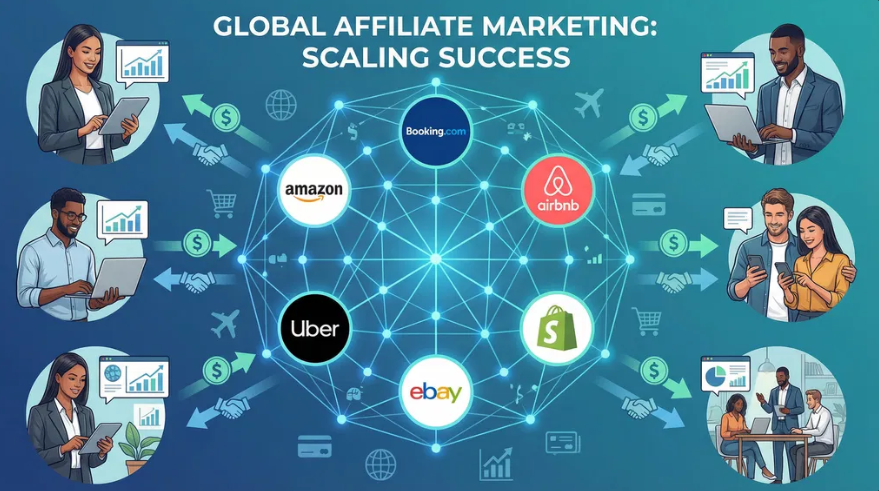
How Amazon & Booking.com Built Empires with Affiliate Marketing
Introduction
Affiliate marketing is not a niche strategy; it is a multi-billion-dollar industry that has been the silent growth engine behind some of the world's most recognizable brands. From e-commerce behemoths to travel industry titans, companies across every sector have harnessed the power of partnerships to scale their reach, acquire customers, and build empires. This performance-based model, where companies reward partners for driving specific actions, has proven to be one of the most effective and scalable marketing channels in existence.
While many associate affiliate marketing with small bloggers or influencers, the reality is that its most successful practitioners are global corporations. They have built sophisticated programs that attract millions of partners, from individual content creators to large media companies, all working to promote their products and services. These programs are a testament to the model's power: when you incentivize a global network to market on your behalf, the growth potential is virtually limitless.
In this article, we will explore how giants like Amazon, Booking.com, Uber, and Shopify have strategically used affiliate marketing to dominate their respective markets. We will dissect their program structures, commission models, and the key lessons that can be learned from their success. Furthermore, we will look to the future, examining how innovative platforms like Slaff.io are taking the core principles of this powerful model and revolutionizing them with blockchain technology, offering unprecedented transparency, security, and efficiency for the next generation of affiliate partners.
1. Amazon Associates: The Pioneer of E-Commerce Affiliate Marketing
When it comes to affiliate marketing, Amazon is the undisputed pioneer. Launched in 1996, the Amazon Associates Program is one of the oldest and largest affiliate programs in the world . It was a revolutionary concept at the time: allow anyone with a website to earn a commission by referring customers to Amazon. This single decision transformed marketing and laid the groundwork for the modern digital advertising landscape.
How It Works
The model is elegantly simple:
1.Sign-Up: Associates sign up for the program and receive a unique tracking ID.
2.Link Creation: They create special affiliate links to any product on Amazon.
3.Promotion: They place these links on their websites, blogs, social media channels, or in their email newsletters.
4.Referral & Tracking: When a user clicks the link, a cookie is placed on their browser. If that user makes a purchase on Amazon within a 24-hour window, the associate earns a commission on the entire sale, not just the product they linked to.
5.Payout: Commissions are paid out on a monthly basis, typically after a 60-day holding period to account for returns.
Why It’s So Successful
Amazon's success with affiliate marketing can be attributed to several key factors:
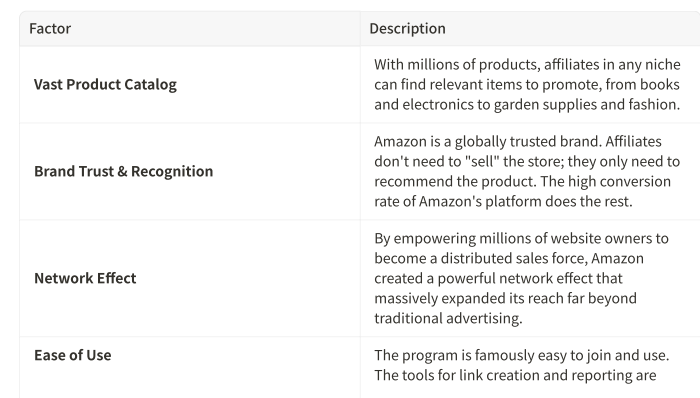

The program is famously easy to join and use. The tools for link creation and reporting are straightforward, making it accessible to even non-technical users.
Amazon’s program demonstrated that a decentralized, performance-based marketing model could drive enormous scale. However, its centralized nature still relies on cookie tracking and is subject to the same payment delays and potential for disputes seen in traditional systems.
2. Booking.com: Dominating the Travel Industry with Partnerships
Booking.com, a subsidiary of Booking Holdings, is a powerhouse in the online travel agency (OTA) space. A significant portion of its market dominance can be attributed to its robust Affiliate Partner Programme, which boasts over 12,500 active partners . Their strategy focuses on integrating their booking functionality directly into the websites and applications of their partners.
How It Works
Booking.com offers a more sophisticated partnership model compared to Amazon:
1.Integration Options: Partners can choose from simple link-based referrals, search boxes, or even fully white-labeled booking engines that are seamlessly integrated into their own sites.
2.Commission Model: Partners earn a percentage of the commission that Booking.com receives from the accommodation. This commission is typically paid out after the guest has completed their stay.
3.Global Inventory: Affiliates get access to a massive inventory of over 28 million accommodation listings, including hotels, apartments, and vacation homes worldwide.
Why It’s So Successful
Booking.com's affiliate strategy is a masterclass in B2B partnerships:
•Value Proposition: They provide immense value to their partners. A travel blogger, for instance, can instantly monetize their content by offering a useful service (hotel booking) directly to their readers without having to build the infrastructure themselves.
•Customizable Solutions: By offering everything from simple links to deep API integrations, they cater to a wide range of partners, from small bloggers to large airlines and travel corporations.
•High Earning Potential: The travel industry has high transaction values, meaning commissions can be substantial. This attracts high-quality, professional affiliate partners.
Booking.com’s success highlights how affiliate marketing can be a core business strategy for B2B growth, creating a symbiotic relationship where both the company and its partners thrive. This model, however, still faces challenges with payment reconciliation and delays, as commissions are only confirmed and paid long after the initial booking is made.
3. Other Giants and Their Affiliate Strategies
The success of Amazon and Booking.com is not an anomaly. Many other industry leaders have built their growth on the back of affiliate marketing.
Uber
Uber's affiliate program, often called a referral program, was instrumental in its explosive early growth. It incentivized both riders and drivers to refer new users. By giving both the referrer and the new user a credit or bonus, Uber created a powerful viral loop. This C2C (Consumer-to-Consumer) model allowed them to penetrate new markets rapidly with minimal traditional marketing spend .
Shopify
Shopify, a leading e-commerce platform, has a highly successful affiliate program that targets entrepreneurs, educators, influencers, and content creators. Affiliates earn a substantial commission for every new merchant they refer to the platform. This B2B-focused strategy has been incredibly effective, as it leverages trusted voices in the business community to recommend their service, creating a powerful stream of high-quality leads .
The Future: Affiliate Marketing on the Blockchain with Slaff.io
While these traditional affiliate programs have been immensely successful, they all share common weaknesses rooted in their centralized, trust-based architecture:
•Payment Delays: Affiliates often wait 30-90 days or more to receive their commissions.
•Lack of Transparency: Tracking is often a "black box," with affiliates having to trust the merchant's data.
•Disputes and Fraud: Cookie-stuffing, link hijacking, and disputes over attribution are common.
•Reversals: Commissions can be reversed weeks or months later if a customer returns a product or cancels a service.
This is where platforms like Slaff.io are pioneering the next evolution of affiliate marketing. By building the entire system on a blockchain and using smart contracts, Slaff.io eliminates these legacy issues entirely.
How Slaff.io Revolutionizes the Model:
1.Instant, Automated Payouts: When a referred user makes an investment, the smart contract automatically and instantly executes the commission payout directly to the affiliate's digital wallet. There are no delays and no manual processing.
2.Unbreakable Transparency: Every referral and transaction is recorded on an immutable public ledger. Attribution is permanent and cannot be disputed or altered.
3.Guaranteed Lifetime Commissions: Smart contracts ensure that an affiliate is tied to their referred user for life. The affiliate will continue to earn commissions on all future investments made by that user, a guarantee that is impossible in traditional systems.
4.Trustless Architecture: The system operates based on code, not trust. Affiliates don't need to trust Slaff.io to pay them; the smart contract guarantees it.
With a growing community of over 70,000 users and a secure platform backed by a $100M insurance policy from BitGo, Slaff.io is demonstrating that the future of affiliate marketing is decentralized, transparent, and automated.
Conclusion
The affiliate marketing model, pioneered by giants like Amazon and perfected by companies like Booking.com, has proven to be one of the most powerful growth engines in modern business. It allows companies to build a global, performance-based sales force, driving scalable and cost-effective customer acquisition. The success of these programs provides undeniable proof of the model's efficacy.
However, the future does not lie in repeating the past. The inherent flaws of traditional, centralized affiliate systems—payment delays, lack of transparency, and the need for trust—are now being solved by blockchain technology. Platforms like Slaff.io are leading this charge, building a new paradigm for affiliate marketing that is faster, fairer, and more secure than ever before.
For affiliates, this means an end to waiting for payments and worrying about tracking errors. For companies, it means a more efficient, transparent, and powerful way to build partnerships and drive growth. The lesson from the giants is clear: affiliate marketing works. The lesson for the future is that blockchain will make it work better for everyone.
Priporočene vsebine / Recommended Reading
- How to Build a Successful Affiliate Business with Slaff.io Blockchain
- Top 10 Marketing Strategies for Slaff.io Affiliates
- Traditional vs Blockchain Affiliate Marketing Complete Guide 2026
- Email Marketing for Affiliates How to Convert Subscribers 2026
- Investra.io Wins Innovation Award at MAK 2026 Conference
- Complete Business Consultant Guide 2026: Choose & Work With Advisors
- Sales Commission Structures 2026: Align Incentives with AI Productivity
- How Amazon & Booking.com Built Empires with Affiliate Marketing
Priporočene vsebine / Recommended Reading
- Affiliate Commission Models Explained: CPA, CPM, Revenue Share 2026
- How Amazon & Booking.com Built Empires with Affiliate Marketing
- Affiliate Marketing Explained The Ultimate Guide to Growth
- The 3 Questions Every CEO Should Ask Before Approving an AI Budget
- Structuring Your Sales Tech Stack in 2026: What to Keep & Cut
Frequently Asked Questions (FAQ)
1. What is the biggest advantage of Amazon's affiliate program?
The biggest advantage is its vast product catalog combined with its universal brand trust. Affiliates in virtually any niche can find relevant products to promote, and they benefit from Amazon's high conversion rates, as customers already trust the platform and are comfortable making purchases there.
2. How does Booking.com's affiliate model differ from Amazon's?
Booking.com focuses on deeper integration and B2B partnerships. While Amazon primarily offers simple link referrals, Booking.com provides customizable tools like search boxes and white-label booking engines. This allows partners to offer a more seamless experience to their users and makes the partnership more of a core business integration rather than just a referral link.
3. Why is affiliate marketing considered a "performance-based" channel?
It is called performance-based because the company only pays the affiliate after a desired action (the "performance") has been completed. This action is typically a sale, but it can also be a lead, a sign-up, or a click. This contrasts with traditional advertising, where companies pay for ad space or impressions regardless of whether those ads lead to a sale.
4. How does blockchain solve the problem of trust in affiliate marketing?
Blockchain solves the trust problem by creating a decentralized, immutable, and transparent system. Instead of relying on a merchant's private database, all referral data and transaction rules are encoded in a smart contract on a public ledger. This means that once a referral is made and a commission is earned, the payment is guaranteed by the code itself, not by the company. It is publicly verifiable and cannot be altered, eliminating the need for trust entirely.
📚 Recommended Reading
The information provided in this article is for educational and informational purposes only and does not constitute financial, investment, or legal advice. Real estate investments involve risk, including the possible loss of principal. Past performance is not indicative of future results. Always conduct your own due diligence and consult with a qualified financial advisor before making any investment decisions. Investra.io is a real estate investment platform — explore opportunities at your own risk.
📚 Priporočene vsebine / Recommended Reading
Razširite svoje znanje z naslednjimi strokovnimi vsebinami:
- 🌐 Siniša Dagary — Business Consultant & Sales Leadership Expert
- 📖 The Shifting Landscape of Global Gold Reserves - 2025 Report
- 📖 Slovenian Real Estate Market 2026: A Complete Analysis & Forecast
Strokovne vsebine: sinisadagary.com — Poslovni svetovalec & Sales Leadership trener
