 English
  Български
  Deutsch
  العربية
  Čeština
  Dansk
Dansk  Ελληνικά
  Español
  Eesti
Eesti  Suomi
Suomi  Русский
  Türkçe
  Français
  Magyar
  Bahasa Indonesia
  Italiano
  日本語
日本語  한국어
한국어  Lietuvių
  Latviešu
  Norsk Bokmål
  Nederlands
  Polski
  Português
  Română
  Slovenčina
  Slovenščina
  Svenska
  Ukrainian
  中文
中文  Srpski
  Hrvatski
Blockchain Payments: How to Send Money Faster and Cheaper in 2026


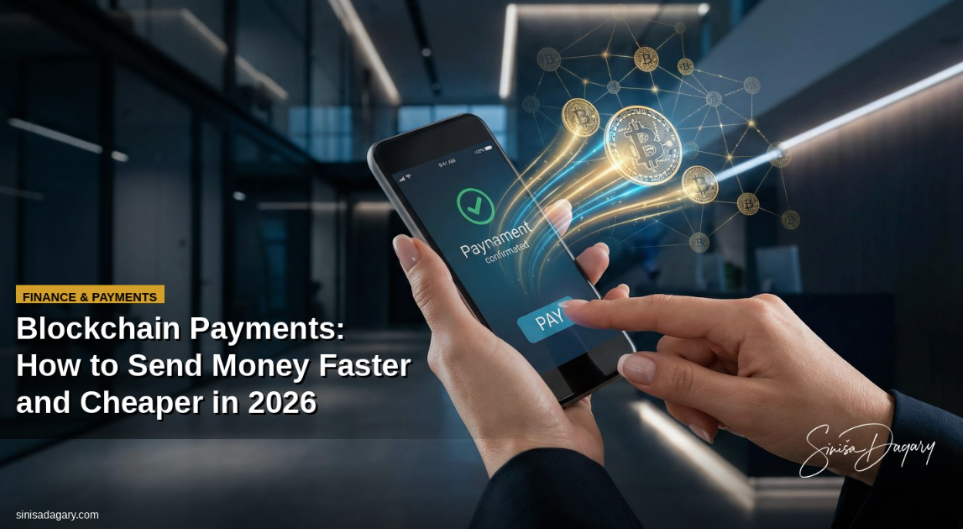
Blockchain Payments: How to Send Money Faster and Cheaper in 2026
Let’s talk about one of the most fundamental, yet frustrating, aspects of running a business: moving money. Whether you’re paying an international supplier, receiving a payment from a customer overseas, or simply trying to process a high volume of small transactions, the traditional financial system is a minefield of delays, high fees, and a frustrating lack of transparency.
I’ve sat in boardrooms with CFOs who tear their hair out over the 3-5 days it takes for a simple wire transfer to clear. I’ve worked with e-commerce businesses that lose a significant chunk of their revenue to credit card processing fees. And I’ve seen promising new business models, like those in the creator economy, struggle to find a cost-effective way to handle a large number of small payments (micropayments).
For decades, we’ve accepted this as the cost of doing business. We’ve relied on a complex web of intermediaries — banks, payment processors, and clearinghouses — to move our money, and we’ve paid a hefty price for the privilege. But what if there was a better way? What if you could send money directly to anyone, anywhere in the world, almost instantly and at a fraction of the cost? That’s the revolution that blockchain technology is bringing to the world of payments.
In this deep dive, we’re going to explore how blockchain is poised to disrupt the multi-trillion dollar payments industry. We’ll look at how it’s solving the age-old problem of slow and expensive cross-border payments, how it’s enabling new business models through micropayments, and how it’s making all our transactions more secure. This isn’t a futuristic fantasy; it’s happening right now. Let’s get into it.
The Problem with Traditional Payment Systems
To understand why blockchain is so revolutionary, we first need to understand why the system it’s replacing is so broken. Our current payment infrastructure was built for a pre-digital world, and it shows. It’s a patchwork of legacy systems that is slow, expensive, and opaque.
Let’s look at the two main areas where the traditional system falls short:
1. Cross-Border Payments: The Slow and Expensive Relay Race
When you send money internationally using a traditional wire transfer, it doesn’t go directly from your bank to the recipient’s bank. Instead, it goes on a journey through a network of correspondent banks. Each bank in the chain takes a fee and adds time to the process. It’s like a relay race where each runner takes a cut of the money and takes a few hours (or days) to pass the baton.
This system, known as the SWIFT network, has a number of major drawbacks:
•Slow: A typical cross-border payment can take 3-5 business days to settle. In a world of instant communication, this is an anachronism.
•Expensive: The fees can be substantial, often ranging from $25 to $50 per transaction, not to mention the hidden costs in unfavorable currency exchange rates. For businesses that make a high volume of international payments, this can add up to a significant expense.
•Opaque: There is often a lack of transparency into the fees and the exact time the payment will arrive. This makes it difficult for businesses to manage their cash flow and can strain relationships with suppliers.
2. Card Payments and Micropayments: The Tollbooth Economy
When a customer pays you with a credit card, the money doesn’t just magically appear in your account. The transaction has to go through a complex network of intermediaries, including the customer’s bank, the card network (like Visa or Mastercard), a payment processor, and your bank. Each of these parties takes a small percentage of the transaction, known as an interchange fee. These fees typically range from 1.5% to 3.5% of the transaction value.
For large transactions, this might seem like a small price to pay for convenience. But for businesses that process a high volume of small transactions (micropayments), these fees can be crippling. Imagine you want to create a news website where you charge readers $0.10 to read an article. A 3.5% fee on that transaction is manageable, but most payment processors also have a fixed fee of around $0.30 per transaction. Suddenly, your $0.10 article is costing you $0.3035 to process. The business model simply doesn’t work.
This is the fundamental problem with our traditional payment systems. They are built around intermediaries who add friction, cost, and delay to the process. Blockchain offers a way to bypass these intermediaries and create a more direct, efficient, and cost-effective way to move money.
How Blockchain is Transforming the Payments Landscape
Blockchain technology offers a fundamentally different approach to payments. Instead of relying on a network of intermediaries, it enables peer-to-peer transactions on a decentralized, distributed ledger. This has a number of profound implications for how we move money.
Blockchain transforms payments by enabling peer-to-peer transactions without intermediaries, making money transfers faster and cheaper in 2026. Reduce fees by up to 70% with blockchain wallets. Learn more at sinisadagary.com
Here are the key ways that blockchain is transforming the payments landscape:
•Disintermediation: This is the big one. By allowing two parties to transact directly with each other, blockchain removes the need for many of the traditional intermediaries that add cost and friction to the payment process. This is what makes faster, cheaper payments possible.
•Speed and Efficiency: A transaction on a blockchain network can be settled in minutes, or even seconds, 24/7/365. This is a dramatic improvement over the multi-day settlement times of the traditional banking system.
•Lower Transaction Costs: By cutting out the middlemen, blockchain can significantly reduce the cost of processing a payment. This is especially true for cross-border payments and micropayments, where the fees of the traditional system are most prohibitive.
•Enhanced Security: The cryptographic security and decentralized nature of blockchain make it extremely difficult for fraudsters to tamper with transactions. Every transaction is recorded on an immutable ledger, creating a transparent and auditable trail.
•Global Accessibility: A blockchain network is global by nature. Anyone with an internet connection can access it, which has the potential to bring financial services to the billions of people around the world who are currently unbanked or underbanked.
As Stripe, a leader in the online payments industry, notes, “Blockchain simplifies the entire payment process by turning the payment itself into a permanent, shared record.” This shared record is the key to creating a more efficient and transparent financial system.
It’s important to note that there are different types of blockchain-based payment solutions. Some, like Ripple, are focused on improving the existing financial system by providing a better infrastructure for banks. Others, like Bitcoin and other cryptocurrencies, are creating an entirely new, alternative financial system. And then there are stablecoins, which are cryptocurrencies that are pegged to a stable asset like the US dollar, offering the speed and efficiency of crypto without the volatility. We’ll explore the implications of each of these in our use cases.
Use Case #1: Instant, Low-Cost Cross-Border Payments
As any business operating on a global scale knows, cross-border payments are a major pain point. The traditional system is a relic of a bygone era, a slow and expensive process that creates cash flow headaches and strains supplier relationships. I’ve seen companies wait a week or more for a critical payment to arrive, all while their funds are in a black box, subject to the whims of multiple intermediary banks.
Traditional cross-border payments often take over a week, leading to delays and high costs. Use blockchain to send money instantly for just a fraction of the fee. Learn more at sinisadagary.com
Blockchain is poised to completely transform this landscape. By enabling direct, peer-to-peer transfers on a global, decentralized network, it can make sending money across borders as easy as sending an email.
How It Works: The RippleNet and Stablecoin Models
There are two primary models for how blockchain is being used to improve cross-border payments:
1.The Banking Infrastructure Model (e.g., RippleNet): Companies like Ripple are not trying to replace banks, but rather to provide them with a better infrastructure. RippleNet is a network of hundreds of banks and financial institutions that use blockchain technology to settle cross-border payments in real-time. Instead of the old, slow SWIFT system, a bank in the US can use RippleNet to send funds to a bank in Mexico in a matter of seconds. The process is transparent, with all fees and exchange rates visible upfront. This is a powerful example of using blockchain to upgrade the existing financial system.
2.The Stablecoin Model: Another approach is to use stablecoins, which are cryptocurrencies pegged to a stable asset like the US dollar (e.g., USDC, USDT). A business can convert its local currency into a stablecoin, send it to a recipient anywhere in the world via a blockchain network like Ethereum or Solana, and the recipient can then convert it back into their local currency. The entire process can take minutes and costs a fraction of a traditional wire transfer. This model effectively bypasses the traditional banking system altogether.
According to a report from J.P. Morgan, the volume of cross-border payments is expected to grow significantly in the coming years, and blockchain is seen as a key technology for modernizing this massive market. The efficiency gains are simply too large to ignore.
The Impact on Your Business
For your business, the implications are huge. Imagine being able to pay your international suppliers instantly, improving your relationships and potentially gaining early payment discounts. Imagine receiving payments from your overseas customers in minutes, not days, dramatically improving your cash flow. Imagine a world where the cost of sending money internationally is measured in cents, not tens of dollars. This is the world that blockchain is creating, and it’s a massive competitive advantage for any business that operates globally.
Use Case #2: Micropayments and the New Creator Economy
The internet has created a world of abundance when it comes to content and digital services. We can stream music, read articles, and watch videos from creators all over the world. But the way we pay for this content is still stuck in the old world. We either pay a monthly subscription for a bundle of content we may not use, or we are subjected to a barrage of ads. The idea of paying a small amount — a micropayment — for a single piece of content has long been a dream, but the high transaction fees of the traditional payment system have made it an economic impossibility.
In 2026, blockchain micropayments enable creators to get paid instantly for small content pieces, like 0.01 BTC per article, bypassing subscriptions and ads. Start by setting up a blockchain wallet for seamless transactions. Learn more at sinisadagary.com
I’ve spoken with countless entrepreneurs in the media and gaming industries who have had to abandon promising business models because they couldn’t find a cost-effective way to process payments of less than a dollar. It’s a major barrier to innovation.
Blockchain and cryptocurrencies are finally making the dream of micropayments a reality.
How It Works: The Lightning Network and Low-Cost Blockchains
Because blockchain transactions don’t have to go through the expensive intermediary network of the traditional financial system, the fees can be dramatically lower. This opens up the possibility of processing transactions that are worth just a few cents, or even fractions of a cent.
There are a couple of key technologies that are enabling this:
1.Layer-2 Scaling Solutions (e.g., the Lightning Network): The Lightning Network is a “layer-2” protocol that runs on top of the Bitcoin blockchain. It allows for off-chain transactions that are nearly instant and have extremely low fees. Users can open a payment channel and conduct a large number of small transactions without having to record each one on the main blockchain. This is ideal for use cases like paying for a few seconds of a streaming video or tipping a content creator.
2.Low-Cost Blockchains: Newer blockchain networks like Solana and Polygon have been designed from the ground up to have very high transaction throughput and very low fees. A transaction on one of these networks can cost a fraction of a cent, making them a perfect fit for micropayment applications.
The New Creator Economy
The ability to process micropayments at scale is enabling a whole new wave of innovation, particularly in the “creator economy.” Imagine a world where:
•You can pay a few cents to read a single premium news article without having to buy a full subscription.
•You can tip a musician a small amount for a song you enjoyed on a streaming platform.
•In a video game, you can buy a new skin for your character for just a few pennies.
This is a world where creators have a direct financial relationship with their audience, and where consumers have more control over how they pay for content. It’s a more efficient and equitable model, and it’s one that is being built on the back of blockchain technology.
Use Case #3: Reducing Fraud in Online and Retail Payments
Payment fraud is a massive and growing problem for businesses. From stolen credit card numbers to chargeback fraud, merchants are losing billions of dollars every year. The traditional payment system is vulnerable because it relies on the transmission of sensitive information. When you swipe your credit card, your card number, expiration date, and security code are sent across a network, creating multiple opportunities for that data to be intercepted by malicious actors.
Blockchain payments reduce fraud in online and retail transactions by securely eliminating sensitive data transmission, helping merchants save billions of dollars annually from losses. Adopt blockchain for faster, safer payments. Learn more at sinisadagary.com
Blockchain offers a more secure model for payments, one that doesn’t require the transmission of sensitive data.
How It Works: Public Key Cryptography
When you make a payment using a cryptocurrency, you’re not sending your account information. Instead, you’re using a private key to sign a transaction, which authorizes the transfer of funds from your digital wallet to the recipient’s wallet. This transaction is then broadcast to the network and recorded on the blockchain. The recipient can verify the transaction using your public key, but they never have access to your private key or any of your sensitive information.
This model has a number of security advantages:
•No Sensitive Data Transmission: Because you’re not sending your credit card number over a network, there’s nothing for a hacker to steal.
•Reduced Chargeback Fraud: Blockchain transactions are immutable. Once a payment is made, it cannot be reversed by the sender. This can significantly reduce the problem of chargeback fraud, where a customer makes a purchase and then falsely claims that it was fraudulent in order to get their money back.
•Greater Transparency: All transactions are recorded on a public ledger, which can make it easier to identify and track fraudulent activity.
This increased security can lead to lower fraud-related losses, reduced compliance costs, and greater peace of mind for both you and your customers.
Use Case #4: improving B2B Payments and Invoicing
This section explores the flaws of traditional payment systems, highlighting their inefficiencies. Cross-border payments are slow and costly due to multiple intermediaries. It often takes days for transactions to complete, making the process frustrating. Learn more at sinisadagary.com
The process of business-to-business (B2B) payments is often even more complex and inefficient than consumer payments. It typically involves purchase orders, invoices, and a manual reconciliation process that can take weeks or even months. This ties up working capital and creates a significant administrative burden for both the buyer and the seller.
I worked with a large manufacturing company that had a team of people whose sole job was to chase down unpaid invoices and reconcile payments. It was a slow, frustrating, and expensive process.
Blockchain, combined with smart contracts, can automate and improve this entire workflow.
How It Works: Smart Invoices
Imagine you have a supplier who sends you a shipment of raw materials. With a blockchain-based system, the process could look like this:
1.Smart Contract: A smart contract is created that defines the terms of the agreement: the price, the quantity, the delivery date, and the payment terms.
2.Automated Verification: When the shipment arrives at your warehouse, an IoT sensor could automatically verify that the correct quantity of goods was received. This event is recorded on the blockchain.
3.Automated Payment: The smart contract, seeing that the conditions of the agreement have been met, automatically triggers a payment to the supplier. The payment could be made in a stablecoin or another digital currency, and it would be settled in minutes.
This entire process is automated, transparent, and self-executing. There are no invoices to process, no manual reconciliation to perform, and no delays in payment. It’s a system that can achieve significant efficiencies and free up working capital for both you and your suppliers.
The Business Case for Blockchain Payments: A Clear ROI
Blockchain is transforming the payments landscape by enabling peer-to-peer transactions on a decentralized ledger. It eliminates intermediaries, reducing costs and friction in the payment process. A key benefit is disintermediation, which can make transactions significantly faster. Learn more at sinisadagary.com
The business case for adopting blockchain payments is one of the clearest in the entire blockchain ecosystem. The ROI is driven by a combination of cost savings, increased efficiency, and enhanced security.
Let’s look at the numbers:
Benefit Category
Description
Potential ROI
Reduced Transaction Fees
By bypassing the traditional intermediary network, blockchain can dramatically reduce the cost of processing payments, especially for cross-border transactions and micropayments.
Up to 80% reduction in remittance costs for cross-border payments. Enables new business models based on micropayments.
Faster Settlement Times
Blockchain payments can be settled in minutes, not days. This improves cash flow, reduces working capital requirements, and strengthens supplier relationships.
From 3-5 business days for a wire transfer to a few minutes for a blockchain transaction.
Reduced Fraud
The enhanced security of blockchain can significantly reduce losses due to payment fraud and chargebacks.
Billions of dollars are lost to payment fraud each year. Even a small reduction can have a major impact on the bottom line.
Increased Automation
Smart contracts can automate the entire invoicing and payment process, reducing administrative overhead and freeing up your finance team to focus on more strategic tasks.
Significant reduction in manual labor costs associated with accounts payable and receivable.
When you add it all up, the potential for cost savings and efficiency gains is enormous. This is not about incremental improvements; it’s about a fundamental shift in the economics of moving money.
How to Get Started with Blockchain Payments in Your Business
This section explores how blockchain revolutionizes cross-border payments by enabling instant, low-cost transfers. It addresses the inefficiencies of traditional systems, where payments can take over a week to process. Learn more at sinisadagary.com
Ready to start exploring the world of blockchain payments? Here’s a simple, three-step guide to get you started.
Step 1: Identify Your Biggest Payment Pain Point
Where is the most friction in your current payment processes? Are you losing a lot of money on cross-border wire transfer fees? Are credit card processing fees eating into your margins? Are you struggling with a slow and manual B2B invoicing process? Start by focusing on the area where you have the most to gain.
Step 2: Explore the Solutions
Once you’ve identified your pain point, you can start to explore the different blockchain-based solutions that are available. If your issue is cross-border payments, you might look into services that use RippleNet or stablecoins. If you’re interested in accepting cryptocurrency payments from customers, you could partner with a crypto payment processor like BitPay or Coinbase Commerce. If you want to improve your B2B payments, you might explore a platform that offers smart contract capabilities.
Step 3: Run a Pilot Project
As with any new technology, it’s best to start small. Run a pilot project with a limited scope to test the technology and validate the business case. You could start by using a stablecoin to pay a single international supplier, or by offering cryptocurrency as a payment option on a specific product line. Measure the results. How much did you save in fees? How much faster was the transaction? What was the feedback from your customers or suppliers? Use these learnings to build a business case for a broader rollout.
The Future of Money: Programmable, Automated, and Global
This section explores how blockchain enables micropayments in the new creator economy. It addresses the challenge of high transaction fees in traditional systems, making small payments for individual content like articles or videos economically viable. Blockchain reduces these fees significantly. Learn more at sinisadagary.com
The shift to blockchain-based payments is about more than just saving money on transaction fees. It’s about a fundamental change in the nature of money itself. When money becomes programmable, as it is with smart contracts, it opens up a whole new world of possibilities for automated, intelligent financial services.
Imagine a world where your company’s treasury management is fully automated, with smart contracts that automatically move funds to where they are needed most, invest idle cash, and hedge against currency fluctuations. Imagine a world where complex financial instruments, like derivatives and loans, are created and managed by self-executing code, reducing risk and increasing transparency.
This is the future that blockchain is enabling. It’s a future where money is no longer just a static store of value, but a dynamic, programmable asset. It’s a future that will be more efficient, more secure, and more global than the financial system we have today.
Want to stay ahead of the financial revolution? Investra.io connects you with the most innovative investment opportunities in the digital economy.
Conclusion: Don’t Get Left Behind in the Payment Revolution
This section explores how blockchain reduces fraud in online and retail payments by eliminating the need to transmit sensitive data. Payment fraud costs merchants billions annually, but blockchain offers a secure alternative. Learn more at sinisadagary.com
The way we move money is changing, and it’s changing fast. The traditional payment systems, with their high fees, slow settlement times, and vulnerability to fraud, are being disrupted by a new generation of blockchain-based solutions. This is not a trend that any business can afford to ignore.
Whether you’re a global corporation struggling with the high cost of cross-border payments, an e-commerce business looking for a cheaper way to process transactions, or a creator who wants to build a direct financial relationship with your audience, blockchain offers a better way.
I know that the world of cryptocurrencies and blockchain can seem complex and intimidating. But as we’ve seen, the core concepts are straightforward, and the business case is compelling. The time to start exploring this technology is now. The payment revolution is here. The only question is whether you’ll be a part of it.
Priporočene vsebine / Recommended Reading
- Blockchain for Customer Trust: How Transparency Drives Loyalty in 2026
- Blockchain Payments: How to Send Money Faster and Cheaper in 2026
- What Is Blockchain? The Complete Business Guide for 2026
- Beyond Bitcoin: Complete Visual Guide to Blockchain Investing 2026
- Blockchain Applications: The Complete Business Guide for 2026
- Is it Safe to Buy Property in North Cyprus Now? 2026 Market Analysis
- Holiday Home Investment Guide Northern Cyprus 2026
- Affiliate Commission Models Explained: CPA, CPM, Revenue Share 2026
- TRNC Property Investment Guide 2026: Complete Overview for International Buyers
- TRNC Real Estate Market Statistics 2026: Data & Insights
Priporočene vsebine / Recommended Reading
- The 3 Questions Every CEO Should Ask Before Approving an AI Budget
- Why Empathy is the Only Un-Automatable Sales Skill in 2026
- Human-in-the-Loop Sales Strategy How Tech and Talent Win
- Blockchain for Data Security: How to Protect Your Business in 2026
- Why the Best Sales Leaders in 2026 Are Data Scientists in Disguise
Frequently Asked Questions (FAQ)
This section explores how blockchain improves B2B payments and invoicing by automating processes. It addresses inefficiencies like manual reconciliation, which can take weeks or months, using smart contracts. Learn more at sinisadagary.com
1. Do we have to accept volatile cryptocurrencies like Bitcoin to use blockchain for payments?
No. While you can certainly choose to accept cryptocurrencies, many of the most promising blockchain payment solutions for businesses involve the use of stablecoins, which are pegged to a stable asset like the US dollar. This gives you the benefits of blockchain (speed, low cost) without the price volatility.
2. Are blockchain payments anonymous?
This is a common misconception. While some cryptocurrencies are designed to be private, most blockchains, including Bitcoin and Ethereum, are pseudonymous, not anonymous. Every transaction is recorded on a public ledger, and while your real-world identity is not directly linked to your wallet address, it is often possible to trace transactions back to an individual or entity.
3. Are blockchain payments legal and regulated?
The regulatory landscape for cryptocurrencies and blockchain is still evolving, and it varies from country to country. However, most major economies are working to create clear regulatory frameworks. It’s important to work with a reputable partner and to ensure that you are in compliance with all applicable laws and regulations.
4. How do we handle the accounting and tax implications of blockchain payments?
This is an important consideration. The accounting and tax treatment of cryptocurrencies can be complex. You will need to work with your accounting and legal teams to ensure that you have a clear process for tracking, valuing, and reporting your crypto transactions.
5. What is a “gas fee”?
A gas fee is a transaction fee on a blockchain network, like Ethereum. It’s the amount you pay to the network’s validators to have your transaction processed and included in the blockchain. Gas fees can fluctuate depending on how busy the network is.
6. What is the difference between a crypto payment processor and a direct integration?
A crypto payment processor (like BitPay) is a third-party service that allows you to easily accept cryptocurrency payments. They handle the complexity of managing wallets and converting crypto to fiat currency. A direct integration involves building your own infrastructure to accept and manage crypto payments, which offers more control but also requires more technical expertise.
7. Can we use blockchain for payroll?
Yes. Using blockchain and smart contracts for payroll is a growing use case. It can be used to automate salary payments, ensure that employees are paid on time, and even to enable real-time wage payments for gig economy workers.
8. How does a stablecoin maintain its peg to the US dollar?
There are different models for how stablecoins maintain their peg. Some, like USDC and USDT, are backed by reserves of fiat currency and other assets. For every stablecoin in circulation, there is a corresponding dollar held in a bank account. Others use algorithmic models to maintain their peg.
9. What is a CBDC (Central Bank Digital Currency)?
A CBDC is a digital currency issued by a central bank. It would be a digital version of a country’s fiat currency, like a digital dollar or a digital euro. Many countries are exploring the possibility of issuing CBDCs, which could have a major impact on the payments landscape.
10. Is it too early to adopt blockchain for payments?
While the technology is still evolving, the use cases for blockchain in payments are already here, and the benefits are real. The companies that are starting to experiment with this technology today are the ones that will have a significant competitive advantage in the years to come. It’s not too early to start exploring how blockchain can benefit your business.
Recommended Content
The section 'The Business Case for Blockchain Payments: A Clear ROI' highlights the financial benefits of adopting blockchain for payments. It emphasizes cost savings and efficiency, with up to an 80% reduction in remittance costs for cross-border transactions. Learn more at sinisadagary.com
•Blockchain in Business: The Top 5 Reasons Your Company Can't Afford to Ignore It in 2026
•What is Artificial Intelligence (AI)? The Complete Guide for 2026
•AI in Business: Real-World Use Cases & Applications in 2026
•Smart Contracts: The Ultimate Guide to Automated, Trustless Agreements
•Tokenization of Assets: The Future of Investing in 2026
Looking for smart investment opportunities? Explore Investra.io — the platform connecting investors with tomorrow's opportunities today.
•Finds.si — Find the Best Business Partners in Slovenia
Related Blockchain Articles
This section guides businesses on starting with blockchain payments. It offers a simple three-step process, beginning with identifying your biggest payment pain point, like high cross-border fees. Follow these steps to explore blockchain solutions and save costs. Learn more at sinisadagary.com
•Blockchain in Business: Top 5 Reasons Your Company Can't Ignore It in 2026
•Blockchain for Supply Chain: How to Eliminate Fraud and Inefficiency in 2026
•Blockchain for Data Security: How to Protect Your Business in 2026
•Blockchain for Customer Trust: How Transparency Drives Loyalty in 2026
References
This section explores the future of money through blockchain, focusing on programmable and automated financial systems. It highlights how smart contracts can automate treasury management, including moving funds as needed. Imagine automating complex tasks like hedging against currency fluctuations effortlessly. Learn more at sinisadagary.com
[1] Stripe. (n.d.). Blockchain for Payments: A Guide for Businesses. Retrieved from
[2] J.P. Morgan. (n.d. ). Cross-border payment modernization. Retrieved from
For expert business consulting and strategic advisory services, Findes Group provides comprehensive support for businesses across Slovenia and the broader region.
Connect with Siniša Dagary
The "Conclusion: Don’t Get Left Behind in the Payment Revolution" section emphasizes the urgent shift from traditional payment systems to blockchain solutions. It highlights how blockchain offers faster, cheaper transactions for businesses and creators. Embrace this change to avoid high cross-border payment costs. Learn more at sinisadagary.com
Disclaimer: The information in this article is for informational purposes only and does not constitute financial, legal, or investment advice. Investing in new technologies like blockchain carries inherent risks. You should consult with a qualified professional before making any investment decisions. Never invest more than you are willing to lose.
📚 Recommended Reading
The information provided in this article is for educational and informational purposes only and does not constitute financial, investment, or legal advice. Real estate investments involve risk, including the possible loss of principal. Past performance is not indicative of future results. Always conduct your own due diligence and consult with a qualified financial advisor before making any investment decisions. Investra.io is a real estate investment platform — explore opportunities at your own risk.
📚 Priporočene vsebine / Recommended Reading
Razširite svoje znanje z naslednjimi strokovnimi vsebinami:
Strokovne vsebine: sinisadagary.com — Poslovni svetovalec & Sales Leadership trener
