 English
  Български
  Deutsch
  العربية
  Čeština
  Dansk
Dansk  Ελληνικά
  Español
  Eesti
Eesti  Suomi
Suomi  Русский
  Türkçe
  Français
  Magyar
  Bahasa Indonesia
  Italiano
  日本語
日本語  한국어
한국어  Lietuvių
  Latviešu
  Norsk Bokmål
  Nederlands
  Polski
  Português
  Română
  Slovenčina
  Slovenščina
  Svenska
  Ukrainian
  中文
中文  Srpski
  Hrvatski
Booking.com Affiliate Program: Complete Business Case Study


Booking.com Affiliate Program: Complete Business Case Study
Priporočene vsebine / Recommended Reading
- Traditional vs Blockchain Affiliate Marketing Complete Guide 2026
- Artificial Intelligence: The Complete Business Guide for 2026
- Booking.com Affiliate Program: Complete Business Case Study
- Lake Bohinj: Alpine Paradise Complete Travel Guide
- JSON-LD Schema Markup for Business Websites: The Complete 2026 Guide
- How to Integrate AI into Your Business Strategy in 2026 Guide
- Living in Northern Cyprus: Your Complete Expat Guide
- How Amazon & Booking.com Built Empires with Affiliate Marketing
Priporočene vsebine / Recommended Reading
- Complete Business Consultant Guide 2026: Choose & Work With Advisors
- Scaling Up 2026: Proven Framework for Rapid Business Growth
- Blockchain Revolution in Affiliate Marketing with Smart Contracts
- Managing Remote Sales Teams in a Hybrid World: Complete Guide 2026
- Ethereum vs Bitcoin: What Every Business Leader Needs to Know in 2026
Executive Summary
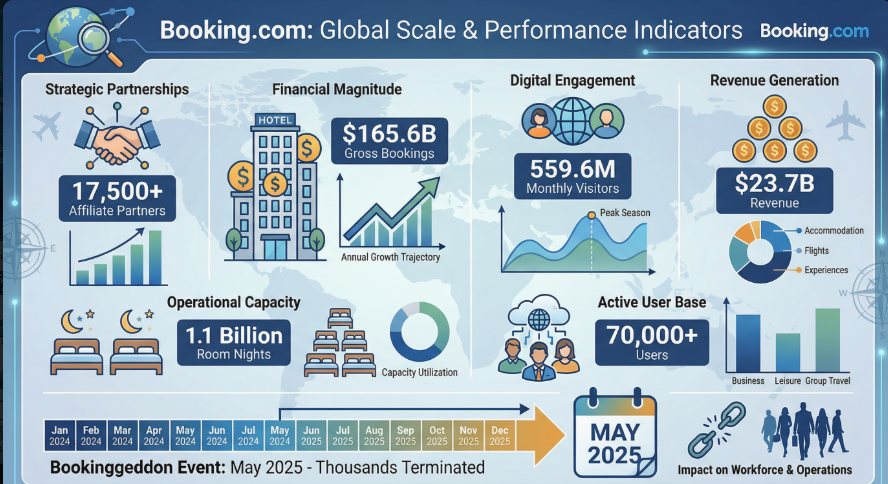
Booking.com operates one of the world's largest and most successful affiliate marketing programs, with over 17,500 affiliate partners generating billions in bookings annually. As a subsidiary of Booking Holdings, the platform has leveraged affiliate marketing as a core growth strategy, contributing significantly to its position as the most visited travel website globally with 559.6 million average monthly visitors. However, in May 2025, the company made headlines by terminating thousands of smaller affiliate partnerships in what became known as "Bookinggeddon," marking a strategic shift toward efficiency, fraud prevention, and partnerships at scale.
Company Overview: Booking Holdings & Booking.com
Corporate Structure
Booking.com is the flagship brand of Booking Holdings, headquartered in Amsterdam, Netherlands. The parent company operates multiple travel brands including Priceline, Agoda, Kayak, OpenTable, and others, creating a comprehensive travel ecosystem.
Market Position
•Largest online travel agency (OTA) by revenue with 35% total market share
•Most visited travel website globally (March 2024) with 6.6% of all desktop traffic in the travel and tourism category
•3.4 million properties listed, including 475,000 hotels, motels, and resorts, plus 2.9 million homes and apartments
•Operations in 220+ countries and territories
•Platform available in 40+ languages
•Flight bookings in 55 markets
•Tours and activities in 1,300+ cities
Financial Performance: Record-Breaking Growth
2024 Financial Highlights
Booking Holdings achieved exceptional financial performance in 2024, demonstrating the strength of its business model and market position:
•Total Revenue: $23.7 billion (11% growth from 2023)
•Gross Bookings: $165.6 billion
•Net Income: Approximately $6 billion
•Operating Income: Approximately $6 billion
•Net Income per Diluted Share: $172.69 (47% increase year-over-year)
•Adjusted Net Income per Diluted Share: $187.10 (23% increase)
Booking Volume Metrics
The scale of Booking.com's operations is staggering:
•Room Nights Booked: 1.1 billion in 2024 (9% growth year-over-year)
•Daily Room Nights: 2.5 million room nights booked per day
•Car Rentals: 80 million days facilitated
•Flight Bookings: Nearly 50 million airline tickets sold
2023 Financial Performance
•Gross Bookings: $150.6 billion (24.2% increase from 2022)
•Total Revenue: $21.4 billion (25% increase)
•Marketing Spending: $6.8 billion (13% increase, but improved efficiency)
•Merchant Gross Bookings: +51.7% (reflecting shift to merchant model)
•Agency Bookings: +2.3%
•Air Ticket Bookings: +64%
•Transaction/Call Center Costs: $2.7 billion (38.2% increase)
•Personnel Costs: $3.3 billion
•General & Administrative Expenses: $1.6 billion
•IT Spending: $655 million (24.5% increase)
Investment Performance
Booking Holdings has significantly outperformed competitors in stock market performance:
•Pre-COVID Stock Price: $2,086.90
•November 2023 Stock Price: $2,776.93
•Growth: +33.1%
•Investment Return: $100 invested in 2018 was worth $205.94 by end of 2023
Competitor Stock Performance (Pre-COVID to Nov 2023):
•Booking Holdings: +33.1%
•Marriott International: +22.2%
•Airbnb: -16.5%
•Expedia Group: -31.4%
•Trip.com Group: -24.7%
•TripAdvisor: -77.2%
•Trivago: -85.1%
Workforce
•Total Employees: 23,600 (as of December 2023)
•3,100 in the United States
•20,500 internationally
•Employment Type: 99% full-time staff
•Strong focus on diversity, equity, and inclusion (DEI)
•Comprehensive leadership development programs
•Multiple employee resource groups
The Affiliate Program: Structure and Economics
Program Overview
Booking.com's affiliate program serves as a critical marketing channel, allowing partners to promote accommodations, flights, car rentals, and activities in exchange for performance-based commissions. The program has been instrumental in the company's global expansion and market penetration.
Affiliate Partner Base
•Total Affiliate Partners: 17,500+ (as of 2025, before May cuts)
•Partner Types: Travel bloggers, content creators, airlines, travel agencies, comparison sites, tour operators, and travel businesses
•Geographic Distribution: Global, with significant concentration in Europe
Commission Structure
Affiliates earn a percentage of Booking.com's commission from hotels and other service providers:
•Commission Rate: 25% to 40% of Booking.com's commission
•Booking.com's Hotel Commission: Approximately 15% of booking value
•Example Earnings: $15 to $25 commission for a $250 hotel stay
•Payment Timing: After guest completes their stay (to prevent fraud from cancellations)
Partnership Models
1.Direct Affiliate Program: Partners sign up directly with Booking.com
2.White-Label Solutions: Custom booking engines for larger partners
3.API Integrations: Technical integrations for major travel companies
4.Third-Party Networks: CJ (Commission Junction) and Awin for smaller affiliates (post-2024)
Major Affiliate Partners
Booking.com maintains strategic partnerships with major travel companies:
•Southwest Airlines
•Kiwi (flight aggregator)
•AirFrance-KLM
•Wizz Air
•easyJet
•Omio/Rome2Rio (ground transportation)
•Civitatis (tours and activities)
The "Bookinggeddon" Event: May 2025 Affiliate Purge
What Happened
In May 2025, Booking.com sent termination notices to thousands of smaller affiliate partners, giving only 30 days' notice before ending partnerships on June 20, 2025. The travel networking platform Travel Massive dubbed this event "Bookinggeddon," and industry sources estimated that thousands of affiliates were affected.
Who Was Terminated
The cuts primarily targeted smaller-scale partners:
•Travel bloggers with 10+ years of partnership history
•Content creators generating 250+ yearly bookings
•Small travel businesses
•Independent travel websites
•Primarily European-based affiliates
Who Was Retained
Large-scale partners with substantial booking volumes were unaffected:
•Major airlines (Southwest, AirFrance-KLM, Wizz Air, easyJet)
•Flight aggregators (Kiwi)
•Transportation platforms (Omio/Rome2Rio)
•Tours and activities operators (Civitatis)
Reasons for Termination
1. Cost Reduction Initiative
The affiliate cuts were part of Booking Holdings' broader $400-450 million cost-cutting initiative announced in December 2024. The program allowed the company to:
•Reduce sales and marketing expenses
•Lower employee overhead for affiliate relationship management
•Trim commission payouts to smaller partners
•Improve operational efficiency
2. Fraud Prevention
Booking.com identified fraud as a significant concern with smaller affiliate partners:
•Fake listings appearing on the platform
•Scammers breaking into hotel systems and messaging customers
•Fraudulent payment schemes targeting Booking.com customers
•Reputational risk from affiliate partner security issues
According to Booking Holdings' February 2025 annual financial filing, "adverse publicity about privacy or security issues at affiliate partners could hurt the brand and its reputation among customers, and could potentially make the company liable for damages."
3. Operational Complexity
Managing thousands of small affiliate relationships created significant operational burden:
•High employee-to-revenue ratio for small partners
•Complex compliance and monitoring requirements
•Resource-intensive relationship management
•Inefficient use of personnel
4. Focus on Scale
Booking.com decided to concentrate resources on partners generating substantial booking volumes, improving overall program efficiency and return on investment.
Impact on Affected Affiliates
The terminations created significant challenges for content creators and small travel businesses:
•Immediate income loss from established revenue streams
•Extensive rework required: Updating or removing affiliate links across hundreds of blog posts
•No advance warning beyond the 30-day notice period
•No explanation provided in termination letters
•Frustration and confusion about alternative options
One Reddit user commented: "I received the same email from Booking.com too about 1 hour ago. Like you, I've had my account for more than 10 years, and I'm very frustrated about this."
Another stated: "Same, with a 9 year old blog here and 250+ yearly affiliate bookings. I can't even think how long it'll take me to remove or update the links on over 400 blog posts."
New Strategic Direction
Redirection to Third-Party Networks
Beginning in late 2024, Booking.com started directing new applicants and displaced affiliates to third-party affiliate networks:
•CJ (Commission Junction)
•Awin
•Regional variations based on applicant location
This strategy provides several benefits:
•Affiliates maintain indirect access to Booking.com inventory
•Booking.com reduces direct operational burden
•Lower commission costs through wholesale arrangements
•Outsourced relationship management and compliance
•Third-party networks handle fraud monitoring and payouts
Industry Response
Alternative Providers Emerging
Several companies moved quickly to capture displaced affiliates:
•CEO Ephraim Spiro reported increasing sign-ups from former Booking.com affiliates
•Offers 10% commissions on properties with direct relationships
•Positions itself as a more partner-friendly alternative
Stay22
•Co-founder and CEO Andrew Lockhead noted: "Operating an affiliate program at scale is increasingly complex. Between rising operational costs, fraud prevention, compliance demands, and constantly evolving monetization models, it's no surprise that even the largest players in travel are being forced to reassess how they manage performance marketing."
•Offers reliable tracking and payout services
•Helps brands maintain performance without compromising efficiency
Industry Commentary
Verónica de Iscar, Chief B2B Sales Officer at Civitatis, provided a critical perspective:
"Affiliate programs must evolve, yes — but not at the expense of the people who have helped build the value of our brands through quality content and trust-based relationships. It is crucial that the industry continues to recognize and support the broader community of creators, who also play a vital role in driving inspiration and trust across the travel ecosystem."
Broader Context for Content Creators
The Booking.com terminations occurred amid multiple challenges facing travel content creators:
•Macroeconomic uncertainties affecting travel spending
•AI revolution disrupting traditional content creation
•Google SEO algorithm changes reducing organic traffic
•Platform policy changes eliminating revenue streams
Key Lessons and Implications
For Affiliate Marketers
1.Diversification is critical: Relying on a single affiliate program creates vulnerability
2.Scale matters: Platforms increasingly favor high-volume partners
3.Fraud prevention is paramount: Security and compliance are non-negotiable
4.Third-party networks offer stability: Indirect relationships may be more sustainable
5.Build direct relationships: Own your audience and revenue streams
For Affiliate Programs
1.Operational efficiency drives decisions: Cost-per-acquisition must justify relationship management
2.Fraud risk increases with scale: Smaller partners may attract disproportionate fraud
3.Third-party networks reduce burden: Outsourcing can improve efficiency
4.Communication matters: Abrupt terminations damage brand reputation
5.Balance scale with community: Long-term brand value includes creator relationships
For the Travel Industry
1.Consolidation continues: Market leaders focus on high-value partnerships
2.Technology enables efficiency: API integrations and automation reduce costs
3.Fraud is an industry-wide challenge: Collaborative solutions are needed
4.Content creators drive value: Quality content builds trust and inspiration
5.Alternative models emerging: Direct booking platforms and new networks fill gaps
Comparison with Slaff.io's Blockchain Approach
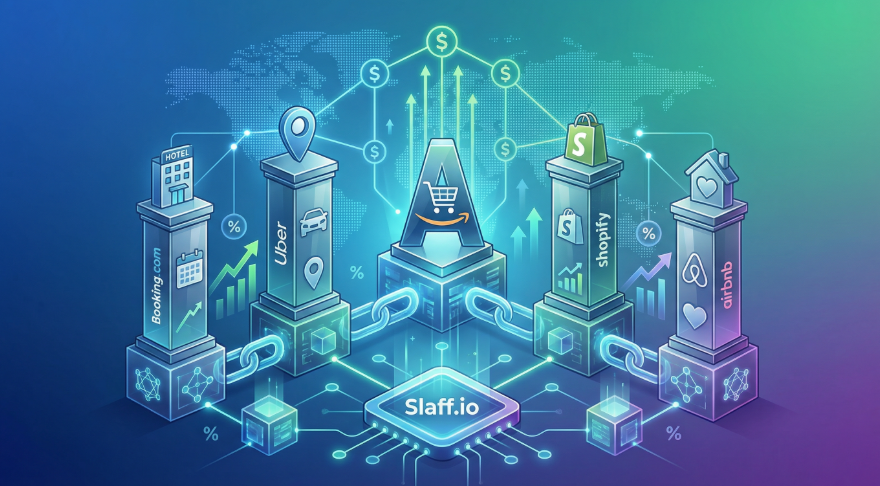
The Booking.com case study highlights several challenges that Slaff.io's blockchain-based affiliate program directly addresses:
Transparency and Trust
Booking.com Challenge: Affiliates received no explanation for terminations and had limited visibility into commission calculations.
Slaff.io Solution: All affiliate relationships and commission payments are recorded on the blockchain, providing complete transparency and immutability. Partners can verify every transaction independently.
Payment Security
Booking.com Challenge: Payments occur after guest stays, creating delays and potential disputes.
Slaff.io Solution: Smart contracts execute automatic payments based on predefined conditions, eliminating delays and disputes. Commissions are guaranteed through code, not corporate policy.
Lifetime Commissions
Booking.com Challenge: Partnerships can be terminated at will, eliminating future earnings from past referrals.
Slaff.io Solution: Blockchain-recorded affiliate relationships ensure lifetime commission payments that cannot be revoked. Once recorded on-chain, the relationship is permanent.
Fraud Prevention
Booking.com Challenge: Fraud from smaller affiliates created reputational and financial risk.
Slaff.io Solution: Blockchain verification and smart contract automation reduce fraud opportunities. All transactions are traceable and auditable.
Operational Efficiency
Booking.com Challenge: Managing thousands of affiliate relationships required significant personnel resources.
Slaff.io Solution: Smart contracts automate relationship management, commission calculations, and payments, dramatically reducing operational overhead.
Partner Stability
Booking.com Challenge: Affiliates lost income streams overnight with 30 days' notice.
Slaff.io Solution: Blockchain-recorded partnerships provide permanent stability. The decentralized nature prevents arbitrary terminations.
Conclusion
Booking.com's affiliate program represents both the tremendous potential and inherent challenges of traditional affiliate marketing at scale. With 17,500+ partners, $165.6 billion in gross bookings, and 1.1 billion room nights booked annually, the program has been a cornerstone of the company's success as the world's leading online travel agency.
However, the May 2025 "Bookinggeddon" event—terminating thousands of smaller affiliates with 30 days' notice—exposed fundamental weaknesses in centralized affiliate programs: lack of transparency, arbitrary termination rights, fraud vulnerabilities, and operational complexity.
The case demonstrates why blockchain-based affiliate platforms like Slaff.io represent the future of performance marketing. By leveraging smart contracts, immutable blockchain records, and decentralized architecture, Slaff.io eliminates the trust issues, payment delays, and termination risks that plague traditional programs.
For investors and affiliate partners evaluating opportunities in the rapidly evolving affiliate marketing landscape, the Booking.com case study provides a clear contrast: traditional centralized programs prioritize corporate efficiency over partner stability, while blockchain-based platforms like Slaff.io create permanent, transparent, and mutually beneficial relationships that cannot be arbitrarily terminated.
The future of affiliate marketing is decentralized, transparent, and built on blockchain technology—and Slaff.io is leading that transformation.
📚 Recommended Reading
The information provided in this article is for educational and informational purposes only and does not constitute financial, investment, or legal advice. Real estate investments involve risk, including the possible loss of principal. Past performance is not indicative of future results. Always conduct your own due diligence and consult with a qualified financial advisor before making any investment decisions. Investra.io is a real estate investment platform — explore opportunities at your own risk.
📚 Priporočene vsebine / Recommended Reading
Razširite svoje znanje z naslednjimi strokovnimi vsebinami:
- 🌐 Siniša Dagary — Business Consultant & Sales Leadership Expert
- 📖 Scaling Up: The Proven Framework for Rapid and Sustainable Business Growth in 2026
- 📖 The Complete Business Consultant Guide: How to Choose and Work With Advisors in 2026
Strokovne vsebine: sinisadagary.com — Poslovni svetovalec & Sales Leadership trener


