English
  Български
  Deutsch
  العربية
  Čeština
  Dansk
Dansk  Ελληνικά
  Español
  Eesti
Eesti  Suomi
Suomi  Русский
  Türkçe
  Français
  Magyar
  Bahasa Indonesia
  Italiano
  日本語
日本語  한국어
한국어  Lietuvių
  Latviešu
  Norsk Bokmål
  Nederlands
  Polski
  Português
  Română
  Slovenčina
  Slovenščina
  Svenska
  Ukrainian
  中文
中文  Srpski
  Hrvatski
Blockchain Revolution in Affiliate Marketing with Smart Contracts


Blockchain Revolution in Affiliate Marketing with Smart Contracts
Introduction: The Affiliate Marketing Crisis and the Blockchain Solution
Affiliate marketing has generated over $8.2 billion in revenue in the United States alone and continues to grow at double-digit rates annually. It has become one of the most effective performance-based marketing channels, driving billions in sales for businesses worldwide. Yet despite this massive success, the traditional affiliate marketing model is fundamentally broken.
The problems are systemic and pervasive. Affiliates wait 30 to 90 days for commission payments, never knowing if they will actually receive what they earned. Merchants struggle with attribution fraud, where bad actors claim credit for conversions they did not generate. Both parties operate in an environment of opacity, where tracking data is controlled by centralized intermediaries who charge substantial fees for their services. Trust erodes with every payment delay, every attribution dispute, and every unexplained commission adjustment.
These are not minor inconveniences—they are structural flaws that limit the growth potential of affiliate marketing and create friction between the parties who should be natural partners. Merchants lose confidence in the channel and reduce their investment. Affiliates abandon programs that do not pay reliably or transparently. The entire ecosystem operates at a fraction of its potential efficiency.
Enter blockchain technology and smart contracts. This is not incremental improvement—it is a complete reimagining of how affiliate relationships work. By leveraging distributed ledgers and self-executing code, blockchain eliminates the need for trusted intermediaries, creates permanent transparent records, and automates commission payments instantly. The result is a trustless, frictionless, and hyper-efficient affiliate ecosystem where every participant can verify every transaction and receive instant payment for performance.
This transformation is not theoretical. It is happening now, and it is fundamentally changing how businesses of all types—from large enterprises conducting B2B partnerships to direct-to-consumer brands building influencer networks to individual users referring friends—approach affiliate and referral marketing.
This comprehensive guide examines how blockchain and smart contracts are revolutionizing affiliate marketing across three distinct business models: B2B (Business-to-Business), B2C (Business-to-Consumer), and C2C (Consumer-to-Consumer). For each segment, we will explore what problems blockchain solves, what innovations it brings, and how it is changing the fundamental economics and power dynamics of affiliate relationships.
Understanding the Core Technology: Blockchain and Smart Contracts
Before diving into segment-specific applications, it is essential to understand the two foundational technologies driving this revolution.
What Is Blockchain?
A blockchain is a distributed digital ledger that records transactions across a network of computers in a way that makes the records immutable and transparent. Unlike traditional databases controlled by a single entity, blockchain data is distributed across many nodes, each maintaining an identical copy of the ledger. Once a transaction is recorded on the blockchain, it cannot be altered or deleted—it exists permanently.
For affiliate marketing, this means that every referral, every click, every conversion, and every commission payment can be recorded on a permanent, tamper-proof ledger that all parties can independently verify. There is no central authority controlling the data, no opportunity for records to be manipulated, and no possibility of "lost" referrals or disputed attributions.
What Are Smart Contracts?
Smart contracts are self-executing programs stored on the blockchain that automatically execute when predetermined conditions are met. They are "smart" because they operate autonomously without human intervention, and they are "contracts" because they enforce agreements between parties.
In affiliate marketing, a smart contract might specify: "If User A refers User B, and User B makes a purchase of $1,000, then automatically transfer 10% ($100) to User A's wallet immediately." Once this smart contract is deployed on the blockchain, it executes automatically and irreversibly whenever the conditions are met. No manual processing, no payment delays, no possibility of non-payment.
The Three Revolutionary Benefits
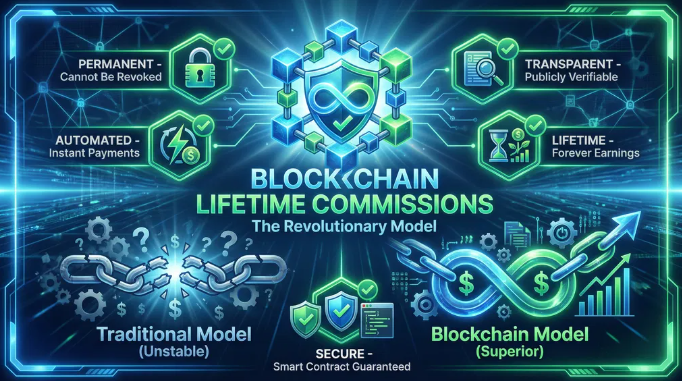
The combination of blockchain and smart contracts delivers three transformative benefits that solve the core problems of traditional affiliate marketing:
1. Transparency: Every transaction is recorded on a public, immutable ledger. Affiliates can independently verify that their referrals were tracked correctly. Merchants can verify that commissions were calculated accurately. Disputes become impossible because the data is objective and permanent.
2. Speed: Smart contracts execute instantly when conditions are met. The moment a referred customer makes a purchase, the commission is automatically calculated and paid. There are no 30-90 day payment cycles, no manual processing delays, no waiting for intermediaries to settle accounts.
3. Trust: In a blockchain system, trust is not required—the technology itself guarantees execution. Affiliates do not need to trust that the merchant will pay them; the smart contract guarantees it. Merchants do not need to trust that affiliates are reporting accurately; the blockchain records it objectively. This "trustless" environment paradoxically creates the highest level of trust possible.
The B2B Revolution: Smart Contracts for Enterprise Partnerships
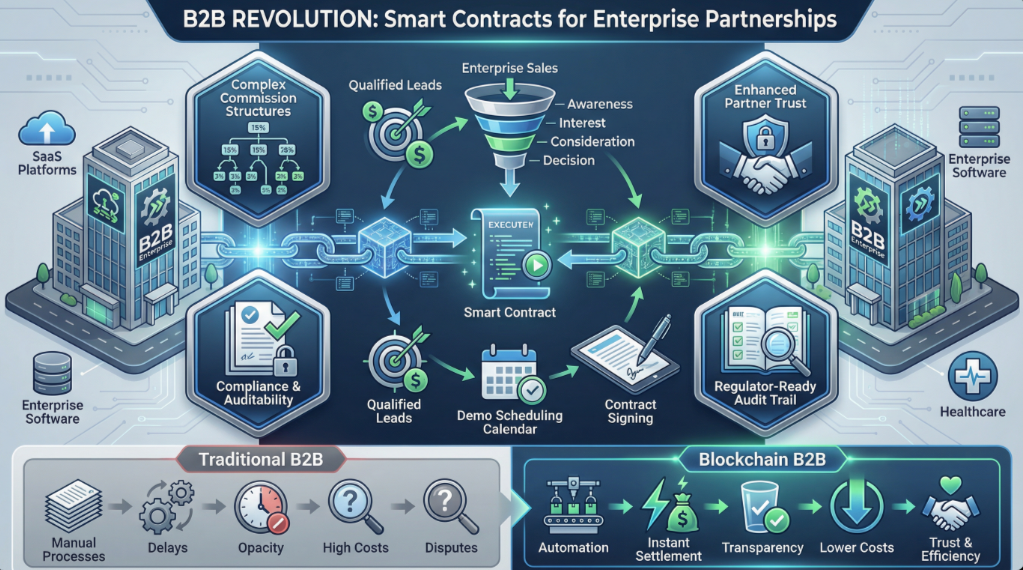
Business-to-business affiliate marketing operates at a completely different scale and complexity than consumer-focused programs. B2B deals often involve high-value transactions (tens or hundreds of thousands of dollars), long sales cycles (months or even years), multiple touchpoints, and complex commission structures that reward different partners for different contributions.
Traditional B2B affiliate programs struggle with these complexities. Tracking multi-touch attributions across long sales cycles is difficult. Calculating commissions for multi-tiered partner networks (where resellers, consultants, and integrators all deserve credit) requires sophisticated systems. Ensuring compliance and auditability in regulated industries adds another layer of complexity. And maintaining trust among enterprise partners when commission calculations are opaque and payments are delayed creates constant friction.
Blockchain and smart contracts solve all of these problems simultaneously, creating a B2B affiliate ecosystem that is transparent, automated, and trustworthy.
What Problems Does Blockchain Solve in B2B?
Complex Commission Attribution
B2B sales rarely involve a single touchpoint. A prospect might be initially referred by a consultant, attend a webinar hosted by a partner, schedule a demo through a reseller, and finally close the deal with the help of an implementation specialist. In traditional systems, determining who deserves credit and how much is a manual, subjective process that often leads to disputes.
Blockchain solves this by creating an immutable record of every touchpoint. The smart contract can be programmed with sophisticated multi-touch attribution rules that automatically allocate commissions based on each partner's contribution. When the deal closes, the smart contract executes instantly, distributing the appropriate commission to each party according to the predefined rules. There is no ambiguity, no manual calculation, and no disputes—the blockchain record is objective and the smart contract execution is automatic.
Payment Delays and Cash Flow Issues
Enterprise sales often involve large commission payments—a 10% commission on a $500,000 software deal is $50,000. In traditional programs, partners wait months to receive these payments while the merchant verifies the sale, processes the paperwork, and runs the payment through accounting systems. This creates cash flow problems for partners and erodes trust in the relationship.
Smart contracts eliminate payment delays entirely. The moment the customer's payment is confirmed on the blockchain, the smart contract automatically executes and transfers the commission to the partner's wallet. The $50,000 commission arrives in seconds, not months. This instant settlement transforms the economics of B2B partnerships, allowing partners to reinvest earnings immediately and creating a powerful incentive to drive more deals.
Compliance and Auditability
B2B companies in regulated industries (financial services, healthcare, government contracting) must maintain detailed audit trails of all transactions, including affiliate commissions. Traditional systems require extensive manual record-keeping, and auditors must trust that the company's internal records are accurate and complete.
Blockchain provides a regulator-ready audit trail automatically. Every referral, every commission calculation, and every payment is recorded permanently on the immutable ledger. Auditors can independently verify the entire history of affiliate transactions without relying on the company's internal systems. This dramatically reduces compliance costs and risk while providing unprecedented transparency for regulators.
Partner Trust and Relationship Strength
B2B partnerships are strategic relationships that can generate millions in revenue over years. These relationships depend on trust—partners must believe they will be compensated fairly for the value they create. Traditional opaque commission systems erode this trust, especially when partners cannot verify that they are receiving credit for all their referrals or that commissions are being calculated correctly.
Blockchain creates unshakable trust by making everything transparent and automatic. Partners can see every referral they generated recorded on the blockchain. They can verify that commission calculations match the agreed-upon terms. They receive payments instantly and automatically. This transparency and reliability strengthens B2B partnerships, encouraging partners to invest more heavily in promoting the product because they know they will be compensated fairly.
What Innovations Does Blockchain Bring to B2B?
Automated Multi-Tiered Commission Structures
Smart contracts can handle arbitrarily complex commission structures that would be impractical to manage manually. A B2B program might reward:
•Consultants who generate qualified leads (5% of deal value)
•Partners who schedule demos (additional 5%)
•Resellers who close deals (15%)
•Implementation specialists who ensure successful deployment (5% ongoing)
A single smart contract can encode all these rules and automatically distribute commissions to the appropriate parties the moment each milestone is achieved. This enables sophisticated partner ecosystems that would be impossible to manage with traditional systems.
Revenue Sharing Across Ecosystems
Blockchain enables new models of collaborative selling where multiple companies work together to serve customers and share revenue automatically. For example, a SaaS platform, a consulting firm, and a data provider might collaborate to serve enterprise clients. A smart contract can automatically split revenue among all three parties based on predefined percentages, with payments executing instantly as customers pay their invoices.
This frictionless revenue sharing enables business models that were previously impractical due to the complexity of tracking and distributing payments among multiple parties.
Portable Reputation and Cross-Platform Partnerships
In traditional B2B affiliate programs, a partner's reputation and relationship history exists only within that specific program. If they want to partner with a different company, they start from zero with no way to prove their track record.
Blockchain creates portable reputation. A partner's entire history of successful referrals, deal closures, and customer satisfaction is recorded on the blockchain as a verifiable credential. This reputation can be leveraged across multiple platforms and partnerships, creating a network effect where successful partners become increasingly valuable and can command better terms.
What Is Changing in B2B?
The fundamental power dynamic of B2B partnerships is shifting. In traditional models, merchants held all the power—they controlled the data, determined the commission calculations, and decided when to pay. Partners had to trust the merchant and had little recourse if they felt they were being treated unfairly.
Blockchain creates a more balanced relationship. The rules are encoded in the smart contract and cannot be changed unilaterally. The data is recorded on the public blockchain where both parties can verify it. Payments are automatic and cannot be withheld. This shifts B2B affiliate marketing from a hierarchical relationship (merchant above partner) to a true partnership of equals operating under transparent, enforceable rules.
The result is stronger, more productive B2B partnerships that drive more revenue for both parties. Partners invest more heavily in promoting products they know will compensate them fairly. Merchants gain access to more motivated partners and can scale their partner ecosystems without the overhead of managing complex commission systems manually.
The B2C Transformation: Instant Rewards and Global Scale
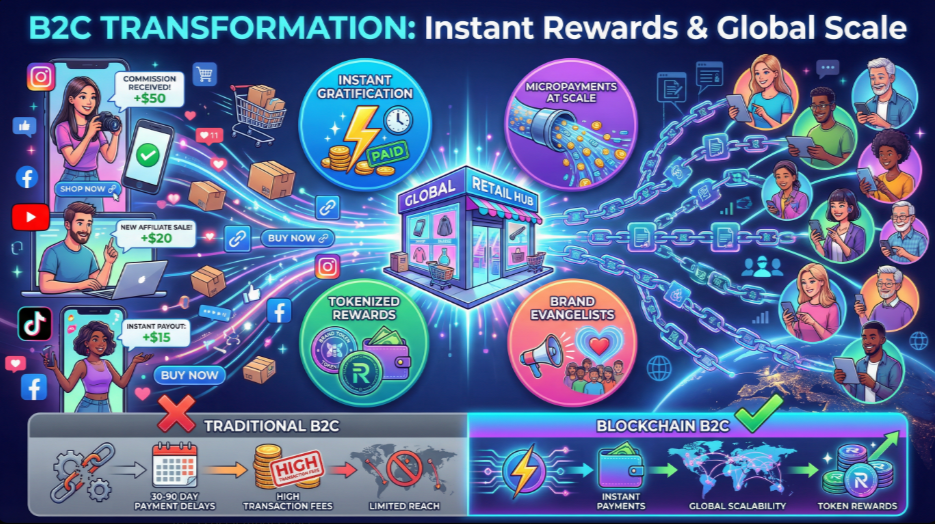
Business-to-consumer affiliate marketing is the largest and most visible segment of the industry. Influencers, content creators, bloggers, and media companies drive billions in e-commerce sales by promoting products to their audiences. Yet B2C affiliate programs suffer from many of the same problems as B2B programs, plus additional challenges unique to the consumer space.
Traditional B2C programs pay affiliates 30 to 90 days after a sale, ostensibly to account for returns and chargebacks. They charge high transaction fees that make small commissions uneconomical to process. They struggle with fraud from affiliates using bots or other deceptive tactics to generate fake conversions. And they operate through centralized networks that take substantial cuts of commissions while providing limited transparency.
Blockchain and smart contracts transform B2C affiliate marketing by enabling instant payments, making micropayments economical, eliminating fraud, and creating new models of engagement through tokenized rewards.
What Problems Does Blockchain Solve in B2C?
Payment Delays and Affiliate Cash Flow
The 30-90 day payment cycle in traditional B2C programs creates significant cash flow problems for affiliates, especially smaller creators who depend on affiliate income to fund their content creation. An influencer who drives $10,000 in sales in January might not receive their $1,000 commission until March or April. This delay makes it difficult to reinvest earnings in content production and creates uncertainty about whether payment will actually arrive.
Smart contracts eliminate this delay entirely. The moment a customer completes a purchase, the smart contract verifies the transaction and instantly transfers the commission to the affiliate's wallet. The influencer who drives sales in January receives payment in January—in fact, they receive payment within seconds of each individual sale. This instant gratification creates a powerful psychological incentive to promote more actively and allows affiliates to reinvest earnings immediately in creating more content.
High Transaction Fees and Micropayment Impossibility
Traditional payment systems charge substantial fees to process transactions—often $0.25 to $0.50 plus a percentage. This makes it uneconomical to pay small commissions. If an affiliate earns a $2 commission on a sale, paying them through traditional systems might cost $0.75 in fees—37.5% of the commission. As a result, most programs set minimum payout thresholds ($50 or $100) and batch payments monthly, which exacerbates the payment delay problem.
Blockchain transactions cost pennies or fractions of pennies, making micropayments economically viable. A brand can pay a $2 commission instantly and the transaction fee might be $0.01—0.5% of the commission. This enables entirely new models of affiliate marketing where brands can reward thousands of micro-influencers with small commissions for each sale, building massive distributed marketing networks that would be impossible with traditional payment systems.
Fraud and Attribution Manipulation
B2C affiliate fraud is a massive problem. Bad actors use bots to generate fake clicks, employ cookie stuffing to steal credit for conversions they did not generate, and create fake accounts to claim commissions fraudulently. Merchants lose billions to affiliate fraud annually, and legitimate affiliates suffer when merchants become overly restrictive in response to fraud concerns.
Blockchain's transparency and immutability make many forms of affiliate fraud impossible or easily detectable. Every click, conversion, and commission is recorded on the public ledger where patterns of fraudulent activity are visible. Smart contracts can encode sophisticated fraud detection rules that automatically flag suspicious activity. And because blockchain identities are cryptographically secured, creating fake accounts becomes much more difficult.
Centralized Network Control and High Fees
Most B2C affiliate marketing operates through centralized networks (like Commission Junction, ShareASale, or Amazon Associates) that act as intermediaries between merchants and affiliates. These networks provide valuable services, but they also take substantial cuts of commissions (often 20-30%), control all the data, and can unilaterally change terms or terminate accounts.
Blockchain enables direct merchant-to-affiliate relationships without intermediaries. A brand can create a smart contract-based affiliate program that affiliates join directly, with commissions paid automatically from the brand to the affiliate with no intermediary taking a cut. This reduces costs for merchants, increases earnings for affiliates, and creates a more transparent relationship where both parties can verify all data independently.
What Innovations Does Blockchain Bring to B2C?
Instant Gratification and Psychological Incentives
The psychological impact of instant payment cannot be overstated. When an influencer promotes a product and sees commission payments arriving in their wallet in real-time as sales occur, it creates an immediate feedback loop that reinforces promotional behavior. This is fundamentally different from the delayed gratification of traditional programs where the connection between promotional effort and payment is separated by weeks or months.
This instant feedback transforms affiliate marketing from a passive income strategy to an active, engaging activity. Affiliates can experiment with different promotional approaches and see immediate results. They can watch their earnings accumulate in real-time during a promotional campaign. This creates a gamification effect that encourages more active and creative promotion.
Micropayments and Mass Market Participation
Traditional affiliate programs are economically viable only for affiliates who can generate substantial volume—typically requiring significant audiences or traffic. A blogger with 1,000 readers might generate a few sales per month, earning commissions too small to justify the overhead of tracking and payment processing.
Blockchain's micropayment capability democratizes affiliate marketing. That same blogger can earn $2 or $5 commissions on individual sales and receive payment instantly with negligible transaction fees. This enables brands to build massive affiliate networks of thousands of micro-influencers, each contributing a small amount of sales, but collectively driving substantial revenue. The long tail of small affiliates becomes economically viable.
Tokenized Rewards and Brand Loyalty
Smart contracts enable brands to create custom tokens that serve as affiliate rewards. Instead of paying commissions in cash, a brand might pay in branded tokens that can be:
•Redeemed for products at a discount
•Exchanged for exclusive access to new products or experiences
•Used to vote on product development decisions
•Traded on cryptocurrency exchanges for cash or other tokens
This creates a deeper relationship between affiliates and brands. Affiliates who hold branded tokens become stakeholders in the brand's success, incentivized to promote more actively because the value of their token holdings increases as the brand grows. This transforms affiliates from transactional partners into true brand evangelists.
Global Reach Without Currency Friction
Traditional affiliate programs struggle with international payments. Paying affiliates in different countries requires currency conversion, international wire transfers, and compliance with multiple regulatory regimes. Transaction fees are high, payment delays are long, and many affiliates in developing countries are effectively excluded from participation.
Blockchain payments are borderless and instant. An affiliate in Nigeria can promote a brand based in Germany and receive commission payments in seconds with the same ease as an affiliate in Berlin. The smart contract handles currency conversion automatically if needed, or payments can be made in stablecoins or cryptocurrency that the affiliate can convert locally. This global reach enables brands to build truly international affiliate networks without the friction of traditional cross-border payments.
What Is Changing in B2C?
The economics of B2C affiliate marketing are fundamentally shifting. Traditional programs concentrated value in large affiliates with substantial audiences because only they could generate enough volume to justify the overhead of participation. Blockchain's instant micropayments democratize participation, enabling anyone with any size audience to earn meaningful income.
This creates a more distributed, resilient, and effective affiliate ecosystem. Brands gain access to thousands of smaller affiliates who collectively drive substantial sales. Affiliates who previously could not participate economically now have opportunities to earn. And consumers benefit from more authentic recommendations from micro-influencers they trust rather than only from mega-influencers promoting dozens of products.
The power dynamic also shifts. In traditional programs, centralized networks controlled the relationship and extracted substantial value. In blockchain programs, merchants and affiliates interact directly under transparent, automated rules, with more value flowing to the parties actually creating and driving sales.
The C2C Democratization: Everyone Can Earn and Own Their Influence
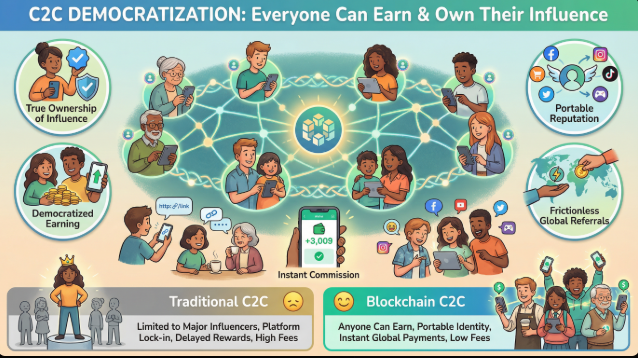
Consumer-to-consumer affiliate marketing—more commonly called referral marketing—is the most personal and potentially most powerful form of marketing. When a satisfied customer recommends a product to a friend, that recommendation carries more weight than any advertisement or influencer endorsement. Yet traditional referral programs capture only a tiny fraction of this potential because they are difficult to participate in, offer delayed rewards, and do not recognize the long-term value of referral relationships.
Blockchain and smart contracts are revolutionizing C2C referral marketing by making it effortless to participate, providing instant rewards, creating portable reputation systems, and enabling anyone to monetize their personal networks regardless of size.
What Problems Does Blockchain Solve in C2C?
Participation Barriers and Friction
Traditional referral programs require users to sign up for affiliate accounts, navigate complex dashboards, generate referral links, and track their referrals manually. This friction prevents most satisfied customers from participating. Even when someone loves a product and wants to recommend it, the effort required to become an "official" referrer is often too high.
Blockchain referral programs can be as simple as sharing a link. When User A shares their unique blockchain-based referral link with User B, the referral relationship is automatically recorded on the blockchain the moment User B clicks the link. No account creation, no dashboard, no manual tracking. The smart contract handles everything automatically, and User A receives commission payments instantly when User B makes purchases. This frictionless participation dramatically increases referral rates.
Delayed and Uncertain Rewards
Traditional referral programs typically offer one-time rewards (often store credit rather than cash) that arrive weeks or months after the referred friend makes a purchase. This delayed gratification reduces the incentive to refer and creates uncertainty about whether the reward will actually materialize.
Blockchain referral programs provide instant cash rewards. The moment the referred friend completes a purchase, the smart contract executes and transfers the commission to the referrer's wallet. The referrer sees the payment arrive in real-time, creating immediate positive reinforcement. And because payments are in cryptocurrency or stablecoins, they are real money that can be spent, saved, or invested—not store credit that can only be used with that specific merchant.
Platform Lock-In and Non-Portable Reputation
In traditional referral programs, a user's referral history and reputation exists only within that specific platform. If they refer 100 friends to Company A and build a reputation as an effective referrer, that reputation has no value when they want to refer friends to Company B. They start from zero with no way to prove their track record.
Blockchain creates portable, verifiable reputation. Every referral a user makes is recorded on the blockchain as part of their permanent identity. This creates an on-chain reputation score that demonstrates their influence and effectiveness. When they participate in new referral programs, they can prove their track record, potentially earning higher commission rates or special status based on their verified history. This portable reputation transforms referral marketing from isolated one-off activities into a cumulative asset that grows more valuable over time.
Limited to Major Influencers
Traditional affiliate and referral programs are economically viable only for users with large audiences or networks. Someone with 100,000 social media followers can drive enough volume to make affiliate marketing worthwhile. Someone with 500 friends cannot—the commissions would be too small to justify the effort of participation.
Blockchain's micropayment capability democratizes earning. A user with a small network can still earn meaningful income because every referral is tracked and paid instantly with negligible transaction fees. Someone who refers five friends and earns $10 per referral has earned $50—real money that arrives instantly. This democratization means anyone can monetize their personal influence, not just major influencers.
What Innovations Does Blockchain Bring to C2C?
True Ownership of Influence
In traditional systems, the platform owns the referral relationship. If the platform changes its terms, terminates the program, or goes out of business, the referrer loses everything. They do not own their referral relationships—they are merely temporary participants in someone else's system.
Blockchain gives users true ownership. The referral relationship is recorded on the public blockchain as an immutable fact. Even if the original platform ceases to exist, the blockchain record remains. In advanced implementations, these referral relationships can even be transferred to other platforms or programs, creating a truly owned asset. This ownership fundamentally changes the value proposition of referral marketing—users are not just earning commissions, they are building permanent assets.
Democratized Earning and Financial Inclusion
Traditional affiliate marketing is largely inaccessible to people in developing countries due to payment friction, minimum payout thresholds, and lack of banking infrastructure. Someone in a rural area of a developing country might not have access to the banking services required to receive international wire transfers or PayPal payments.
Blockchain enables global financial inclusion. Anyone with a smartphone and internet connection can participate in blockchain referral programs and receive payments instantly, regardless of their location or banking status. A user in a developing country can refer friends to products and services and receive cryptocurrency payments that they can convert to local currency through local exchanges or peer-to-peer markets. This democratization creates economic opportunities for billions of people previously excluded from the digital economy.
Frictionless Global Referrals
Traditional referral programs struggle with international referrals. If a user in the United States refers a friend in Japan, the program must handle currency conversion, international payment processing, and compliance with regulations in both countries. Many programs simply do not support international referrals, limiting their reach.
Blockchain referrals are inherently global. A user in any country can refer a friend in any other country, and the smart contract handles everything automatically. Payments can be made in cryptocurrency or stablecoins that work identically worldwide, or the smart contract can handle currency conversion automatically. This frictionless global reach enables referral networks to spread virally across borders without the friction of traditional payment systems.
Gamification and Social Dynamics
Blockchain enables sophisticated gamification of referral marketing. Because all referral data is recorded on the blockchain, programs can create leaderboards, achievement badges, and tiered reward systems that recognize top referrers. These gamification elements can be implemented as NFTs (non-fungible tokens) that users can display as proof of their influence and achievement.
This creates social dynamics that encourage more active participation. Users compete to climb leaderboards, earn achievement badges, and unlock higher commission tiers. The public nature of blockchain data means these achievements are verifiable and can be displayed across platforms, creating social proof of influence.
What Is Changing in C2C?
The fundamental nature of referral marketing is transforming from a nice-to-have feature that merchants offer to a core strategy for customer acquisition and retention. When referral programs are frictionless to participate in, provide instant rewards, and create permanent value for referrers, they become powerful viral growth engines.
This transformation is democratizing earning opportunities. In traditional systems, only major influencers could earn meaningful income from recommendations. In blockchain systems, anyone can monetize their personal network and influence, creating new income opportunities for millions of people.
The relationship between merchants and customers is also changing. When customers become referrers who earn ongoing commissions from the friends they refer, they become stakeholders in the merchant's success. This creates a deeper, more engaged relationship that drives higher customer lifetime value and lower churn.
Real-World Implementation: The Slaff.io and Unifyr Ecosystem
The transformation described in this article is not theoretical—it is being implemented today in real-world platforms. Slaff.io, a premier platform for tokenized investments in real-world assets, has partnered with Unifyr, a blockchain-based connection layer, to create an affiliate and referral program that demonstrates all the benefits of blockchain-powered affiliate marketing.
How Slaff.io and Unifyr Demonstrate the Revolution
Provable Performance and Unshakable Trust
Every referral generated through the Slaff.io affiliate program is tracked on an immutable blockchain ledger. Affiliates can independently verify that their referrals were recorded correctly. There are no "lost" clicks or attribution disputes—the blockchain record is objective and permanent. The smart contract guarantees that if an affiliate drives a sale, they get paid. This creates a fully transparent, trustless system where both parties can operate with complete confidence.
Instant, Automated Global Payouts
The moment a referred user makes their first investment on Slaff.io, the smart contract automatically executes the commission payment. Affiliates do not wait for monthly payout cycles or manual processing. Whether the referral is local or on the other side of the world, payment arrives in seconds. This instant settlement transforms the economics of affiliate marketing and creates powerful incentives for active promotion.
Promoting High-Value, Regulated Products
Slaff.io offers access to tokenized real-world assets like real estate funds and private equity investments, all within a secure and compliant regulatory framework. Affiliates are not promoting low-value consumer products—they are introducing their audience to the future of investing. This high-value proposition means commission payments can be substantial, and affiliates are building genuine value for their audience rather than just driving transactions.
Connected Ecosystem and Compounding Opportunities
Unifyr is building infrastructure for a new generation of interconnected blockchain-based businesses. Affiliates who join the Slaff.io program are positioned at the center of this growing ecosystem. Their Unifyr-based identity and reputation can be leveraged across a network of future partners, creating compounding growth opportunities. As the ecosystem expands, affiliates who established themselves early benefit from network effects and increasing opportunities.
Real-Time Tracking and Meaningful Commissions
The Slaff.io program is designed to be highly competitive, rewarding affiliates generously for bringing quality investors to the platform. With real-time tracking and instant payouts, affiliates can see the direct results of their efforts immediately. This transparency and responsiveness creates a feedback loop that encourages optimization and active promotion.
Why This Model Represents the Future
The Slaff.io and Unifyr partnership demonstrates how blockchain-powered affiliate marketing should work. It combines the transparency and automation of blockchain technology with a high-value product offering and a vision for a connected ecosystem of partners. This is not just an affiliate program—it is a blueprint for the future of performance-based marketing.
As more businesses recognize the advantages of blockchain-powered affiliate programs, this model will become the standard. Merchants will demand the transparency and efficiency that blockchain provides. Affiliates will refuse to participate in programs that do not offer instant payments and verifiable tracking. And the entire industry will shift from centralized, opaque systems to decentralized, transparent networks.
The Path Forward: Adoption Challenges and Timeline
While the benefits of blockchain-powered affiliate marketing are clear, widespread adoption faces several challenges that will determine the timeline for this revolution.
Technical Complexity and User Experience
Blockchain technology is still relatively new and can be intimidating for non-technical users. Affiliates who are comfortable with traditional programs may be hesitant to adopt blockchain-based systems that require cryptocurrency wallets and understanding of blockchain concepts.
The solution is abstraction. Platforms like Slaff.io and Unifyr are building user experiences that hide the technical complexity of blockchain while delivering its benefits. Affiliates interact with familiar dashboards and referral links, while the blockchain technology operates invisibly in the background. As these user experiences improve, the technical barrier to adoption will diminish.
Regulatory Uncertainty
Cryptocurrency and blockchain technology exist in a regulatory gray area in many jurisdictions. Merchants may be hesitant to adopt blockchain-based affiliate programs if they are uncertain about regulatory compliance, especially regarding cryptocurrency payments and tax reporting.
This challenge is being addressed through regulatory clarity and compliant implementations. Platforms like Slaff.io operate within established regulatory frameworks, ensuring that their blockchain-based programs comply with securities laws, anti-money laundering regulations, and tax reporting requirements. As regulatory frameworks mature, this uncertainty will resolve.
Network Effects and Critical Mass
Affiliate marketing benefits from network effects—the more merchants and affiliates participate in a network, the more valuable it becomes. Traditional affiliate networks have spent decades building these networks. Blockchain-based programs start from zero and must build critical mass to compete effectively.
The solution is superior value proposition. Blockchain programs that offer instant payments, higher commissions (due to lower overhead), and better transparency can attract affiliates away from traditional networks. As early adopters demonstrate the benefits, more participants will follow, creating the network effects necessary for mainstream adoption.
Timeline for Transformation
Based on current adoption trends, the transformation of affiliate marketing through blockchain will likely follow this timeline:
2025-2026 (Current Phase): Early Adoption
Forward-thinking platforms like Slaff.io pioneer blockchain-based affiliate programs. Early adopter affiliates experience the benefits and become advocates. Case studies demonstrate superior performance compared to traditional programs.
2027-2028: Growing Momentum
Major e-commerce platforms and B2B companies begin experimenting with blockchain affiliate programs. Regulatory frameworks become clearer. User experience improvements make blockchain programs accessible to mainstream affiliates. Traditional affiliate networks begin integrating blockchain features to remain competitive.
2029-2030: Mainstream Adoption
Blockchain-powered affiliate programs become standard for new programs. Traditional programs face pressure to adopt blockchain features or lose affiliates to competitors. The majority of affiliate commissions are paid through blockchain systems. Portable reputation systems become widely recognized and valued.
2031+: Complete Transformation
Blockchain-based affiliate marketing becomes the default. Traditional centralized networks either adapt or become obsolete. New business models enabled by blockchain (tokenized rewards, portable reputation, cross-platform partnerships) become mainstream. The affiliate marketing industry operates on fundamentally different principles than it did in the 2020s.
Conclusion: The Inevitable Future
The transformation of affiliate marketing through blockchain and smart contracts is not a possibility—it is an inevitability. The benefits are too substantial, the problems solved too fundamental, and the competitive advantages too significant for this revolution to be stopped.
For B2B enterprises, blockchain enables sophisticated partner ecosystems with automated commission structures, instant settlements, and compliance-ready audit trails. For B2C brands, it creates massive distributed marketing networks through micropayments, instant gratification, and tokenized rewards. For C2C referral marketing, it democratizes earning opportunities and creates portable reputation systems that give users true ownership of their influence.
The question is not whether blockchain will transform affiliate marketing, but how quickly businesses will adopt these technologies and which platforms will lead the transformation. Early adopters like Slaff.io are already demonstrating the benefits and building the ecosystems that will define the future of performance-based marketing.
For merchants, the message is clear: blockchain-powered affiliate programs offer superior transparency, lower costs, and access to more motivated affiliates. The competitive advantage of early adoption is substantial.
For affiliates, the opportunity is equally clear: blockchain programs offer instant payments, verifiable tracking, and the ability to build permanent assets through portable reputation. Participating in pioneering programs like Slaff.io positions you at the forefront of this transformation.
The future of affiliate marketing is being built on the blockchain. The revolution has begun.
Priporočene vsebine / Recommended Reading
- Blockchain Payments: How to Send Money Faster and Cheaper in 2026
- How Blockchain and Smart Contracts Transform Affiliate Marketing
- Affiliate vs Referral Marketing Guide for Explosive Growth 2026
- Smart Contracts: The Ultimate Guide to Automated, Trustless Agreements
- How Affiliate Marketing Works on Blockchain with Smart Contracts
- Business Consulting AI Solutions: Transforming Strategy with Intell...
- Customer Success AI: Transforming B2B Relationships with Smart Auto...
- Business Strategy AI: Driving B2B Growth with Smart Decision-Making
Priporočene vsebine / Recommended Reading
- Complete Business Consultant Guide 2026: Choose & Work With Advisors
- Blockchain for Supply Chain: How to Eliminate Fraud in 2026
- Blockchain for Data Security: How to Protect Your Business in 2026
- Sales Commission Structures 2026: Align Incentives with AI Productivity
- Blockchain in Business: Top 5 Reasons to Adopt It in 2026
Frequently Asked Questions (FAQ)
1. Do I need to understand blockchain technology to participate in blockchain-based affiliate programs?
No. Modern blockchain affiliate programs are designed with user-friendly interfaces that hide the technical complexity. You interact with familiar dashboards and referral links, while the blockchain technology operates in the background. You need to understand the benefits (instant payments, transparent tracking, permanent records), but you do not need to understand how blockchain works any more than you need to understand database technology to use traditional affiliate programs. Platforms like Slaff.io make participation as simple as traditional programs while delivering blockchain's advantages.
2. How do I receive payments from blockchain affiliate programs if I don't have cryptocurrency experience?
Most blockchain affiliate programs provide simple onboarding that guides you through setting up a cryptocurrency wallet to receive payments. Many platforms offer the option to automatically convert cryptocurrency payments to traditional currency if you prefer. The process is becoming increasingly streamlined, and as the technology matures, receiving blockchain payments will be as simple as receiving PayPal payments. The key advantage is that once you have a wallet set up, you receive payments instantly rather than waiting weeks or months.
3. Are blockchain affiliate programs legal and compliant with regulations?
Yes, when properly implemented. Reputable platforms like Slaff.io operate within established regulatory frameworks and comply with securities laws, anti-money laundering regulations, and tax reporting requirements. The blockchain technology itself is neutral—it is simply a more transparent and efficient way to track and pay commissions. The legal and compliance considerations are the same as traditional affiliate programs, with the added benefit that blockchain's transparency actually makes compliance easier by providing immutable audit trails.
4. What happens to my referrals if the platform goes out of business?
This is one of blockchain's most powerful advantages. In traditional programs, if the platform closes, you lose everything—your referral relationships, your commission history, and any unpaid earnings. In blockchain programs, your referral relationships are recorded on the public blockchain, which exists independently of any single platform. Even if the original platform ceases operations, the blockchain record remains. In advanced implementations, these referral relationships can potentially be transferred to other platforms or programs, giving you true ownership of the relationships you built.
5. How do blockchain affiliate programs prevent fraud if everything is decentralized?
Blockchain actually makes fraud more difficult, not easier. The transparency of blockchain means that all activity is recorded on a public ledger where patterns of fraudulent behavior are visible and can be analyzed. Smart contracts can encode sophisticated fraud detection rules that automatically flag suspicious activity. And because blockchain identities are cryptographically secured, creating fake accounts is much more difficult than in traditional systems. While no system is completely fraud-proof, blockchain's transparency and immutability make many common forms of affiliate fraud impossible or easily detectable.
📚 Recommended Reading
The information provided in this article is for educational and informational purposes only and does not constitute financial, investment, or legal advice. Real estate investments involve risk, including the possible loss of principal. Past performance is not indicative of future results. Always conduct your own due diligence and consult with a qualified financial advisor before making any investment decisions. Investra.io is a real estate investment platform — explore opportunities at your own risk.
📚 Priporočene vsebine / Recommended Reading
Razširite svoje znanje z naslednjimi strokovnimi vsebinami:
- 🌐 Siniša Dagary — Business Consultant & Sales Leadership Expert
- 📖 The Shifting Landscape of Global Gold Reserves - 2025 Report
- 📖 Slovenian Real Estate Market 2026: A Complete Analysis & Forecast
Strokovne vsebine: sinisadagary.com — Poslovni svetovalec & Sales Leadership trener